
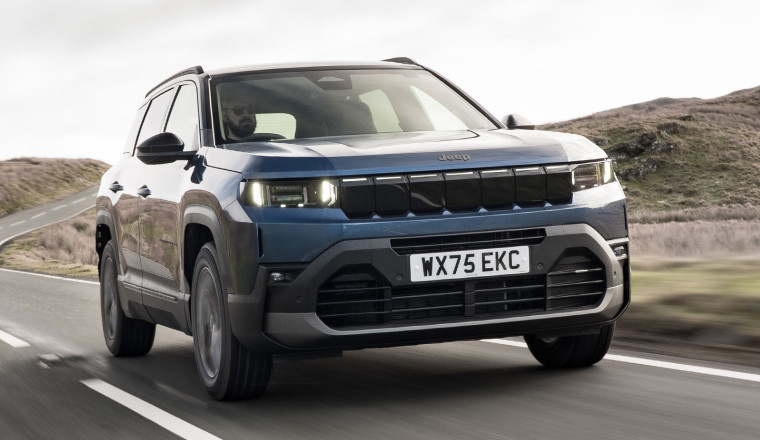

The recent European growth of the Jeep brand has been fuelled by cars big on 4x4 attitude but fairly small in stature: chiefly the Renegade and Avenger. In 2026, the firm’s aiming just a little higher.
This new Jeep Compass becomes the third installment in a particular model lineage that has chronicled its maker’s recent corporate history rather eloquently. The first Compass (2006) was built in North America on DaimlerChrysler platform technology, and was related to the Dodge Caliber (shudder). The second (2016) moved to be built in Italy, on old Fiat mechanicals, under Sergio Marchionne’s FCA Group. The third now adopts the latest Stellantis Group ‘STLA Medium’ platform technology that will eventually deliver full electric, mild hybrid and plug-in hybrid versions.
But the car walks a thin line; because brand values can be cruel. If you’re going to try to honour them, you had better do it faultlessly, lest the enthusiasts pour scorn over your latest product. A Mercedes that isn’t built like a nuclear bunker? Blasphemy! A Ferrari that isn’t the sharpest drive in its class? Humbug!
Yet selling the idea of those values, while becoming more 'flexible' on the actual execution, can work out remarkably well. BMW clearly has few regrets about making the 1 Series front-wheel drive, and a neatly styled miniature electric crossover with a single driven axle won Jeep a Car of the Year trophy for the Avenger.
So has Jeep repeated the same trick so cleverly here in the big-selling Qashqai class?
Verdict
Model tested:
Rating: 6
Jeep Compass
Smart looks, decent powertrains and a roomy boot make this a more sensible, competitive compact SUV than its predecessors; but also more forgettable than some of its siblings.
Good
Smart, Jeep-tough design appeal
Big boot
e-Hybrid model is decent value
Bad
Ride is variously flawed in both the e-Hybrid and EV
Second-row not as roomy or comfortable as rivals
EVs don't qualify for ECG support, so they're pricier than some
INTERIOR
7
Pros
Big boot
Decent front seats
Plenty of good-sized physical controls is a filip to usability
Cons
Not the best infotainment
Back row is a little tight by class standards, and seats aren't very comfortable
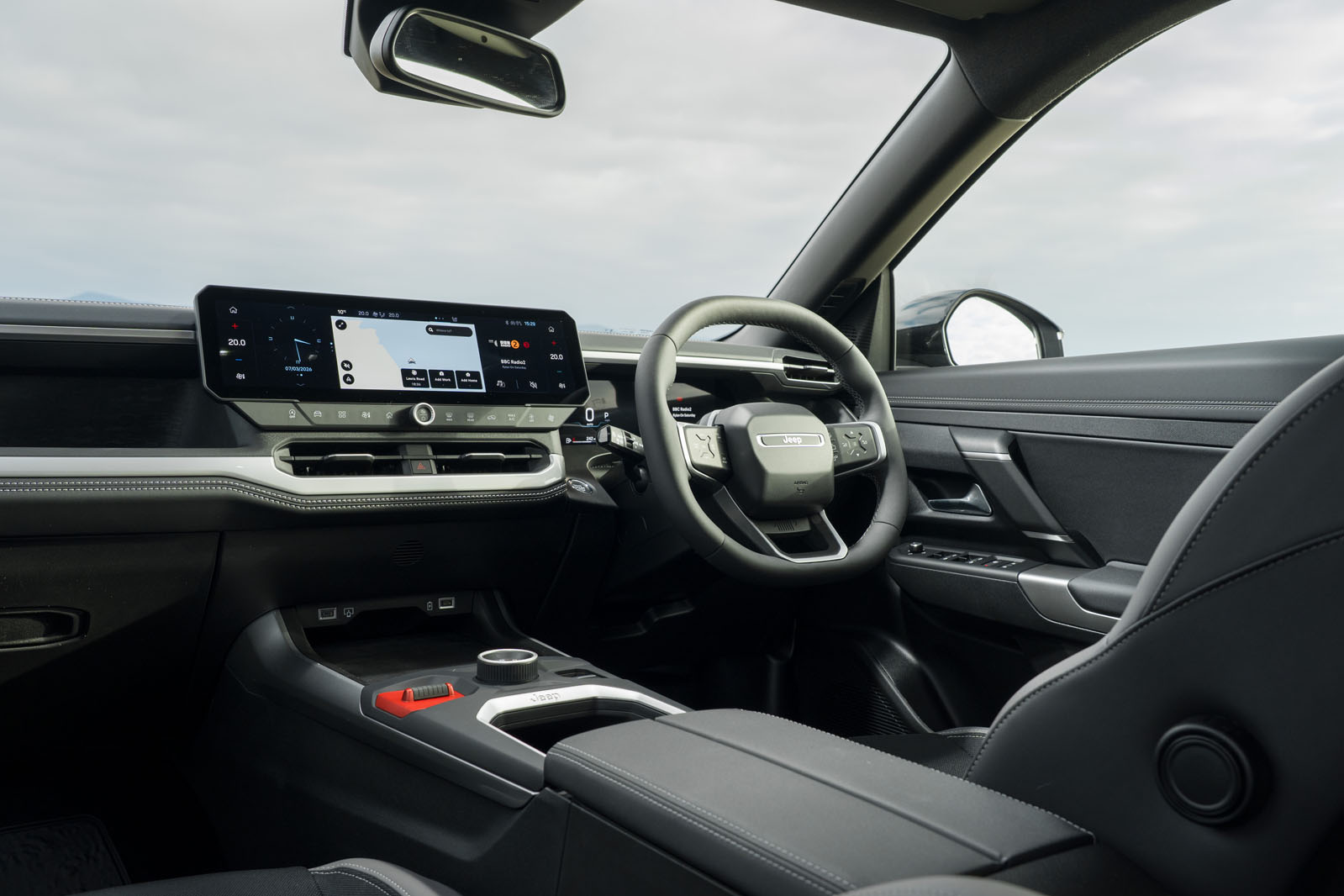
The Compass's interior majors on functionality and ease of use, with lots of useful storage areas across the front row; chunky physical controls for the ‘Selec-Terrain’ drive mode controller and drive selector; and plenty of physical switches to help you navigate the infotainment, control the heater, and turn down the stereo easily.
Material quality is fairly good, though not at sister-brand Peugeot’s level - but there’s a reassuring simplicity and a sense of the conventional about the layout. As we noted with the Citroen C5 Aircross, for these bigger cars there seems to be more variation in switchgear than in the smaller ones. The steering wheel buttons are unique to the Compass, as is the drive mode selector.
Seat comfort up front is fine, though some avenues of adjustment are missing. In the back, passenger space is only average by class standards: the seat cushions are a bit short and flat, and the optional sunroof robs headroom and will annoy taller adult travellers. But boot space is much better: there’s a false floor that can be removed to make room for really bulky things, and 550 litres of volume in all is generous.
The touchscreen infotainment system is supported by a selection of buttons and, unlike in some other Stellantis cars, it actually responds reasonably quickly. Because it’s so wide, you can put plenty of functions on the home screen. It still doesn't have the logical structure you find in a Kia/Hyundai or even a Volkswagen Group product.
ENGINES & PERFORMANCE
7
Pros
EV has configurable and progressive regen
e-Hybrid does a passable job: on the road, and provided you're not in a hurry
Cons
Both versions are slower than key rivals
Hybrid powertrain has some inconsistent drivability habits
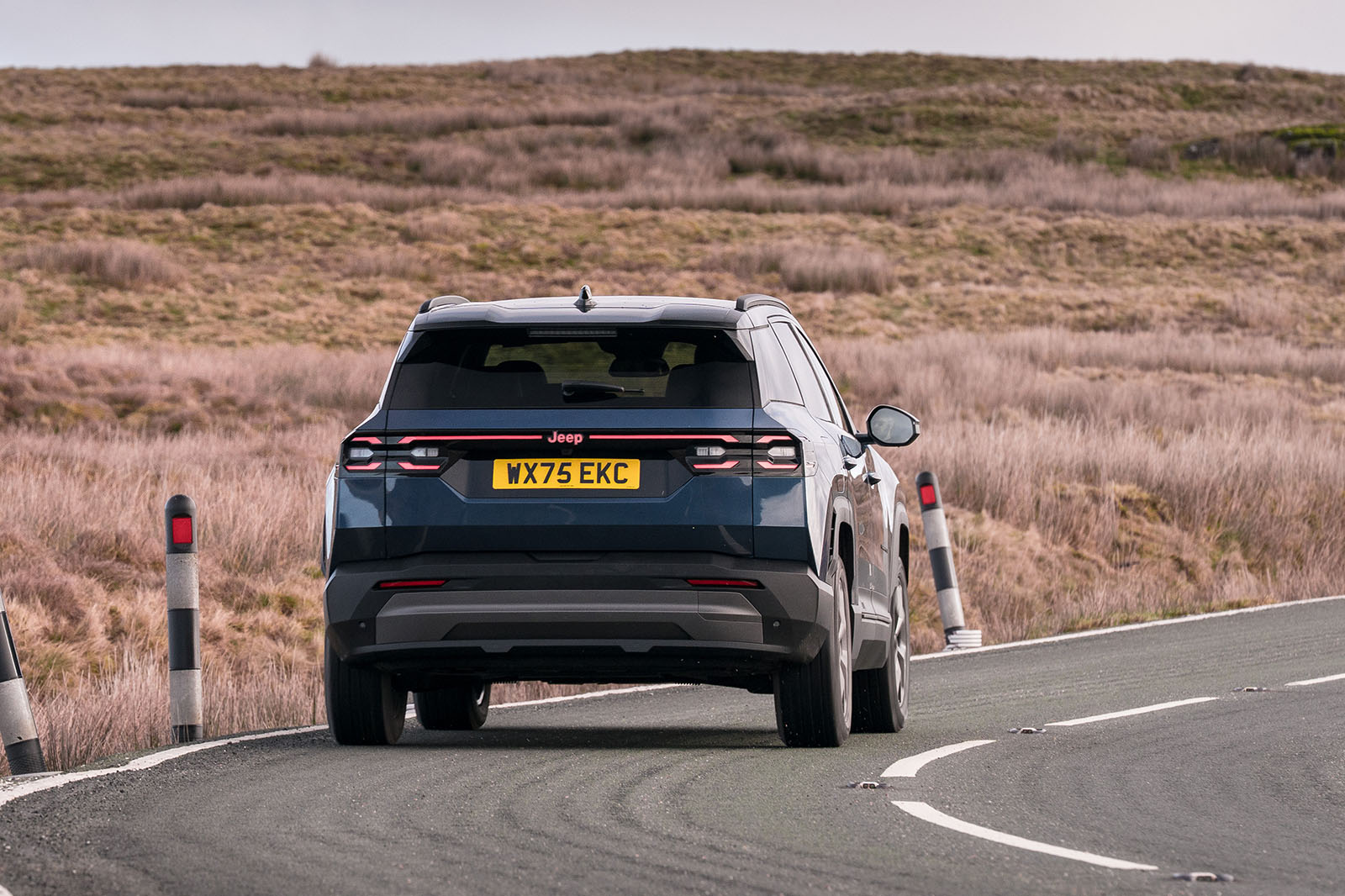
You wouldn’t choose the Compass for how it drives. It has next to no distinguishing features in that respect.
The EV’s 0-62mph time is an unremarkable 8.5sec, because 210bhp stops being a lot when faced with 2.2 tonnes of weight. But it still feels more potent than the e-Hybrid, as well as smoother, quieter and more assured. If price and charging aren't issues, the EV has the powertrain to have.
It has steering-wheel paddles as well as a button to toggle one-pedal driving, so no complaints there.
Most UK Compass buyers are likely to go for the e-Hybrid version, however; and they’ll find it fairly refined, adequately powerful for day to day driving, and respectably economical (think a mixed-route 45mpg).
Even so, there’s no doubt that the hybrid provides the inferior performance. While 144bhp for 1667kg doesn’t make for a horrendous power-to-weight ratio, 10.0sec to 62mph is a little slow by modern standards. Moreover, there can be some momentary delay when you ask for power, and there's certainly some inconsistency in the response and feel of both accelerator and brake pedals, which can seem to have rather too much to do when blending electric motor and combustion, managing regen and shifting gears.
With just 0.9kWh of battery and 28bhp of motor power, this powertrain’s capacity for electric running is very limited in a heavy car. Let the engine rev out and it makes quite an appealing three-cylinder thrum - but it’s the necessity to do that quite so often which undermines the powertrain's sense of authority a bit. It just doesn't feel quite potent enough for a car with pretentions of strength, toughness and versatility.
RIDE & HANDLING
Pros
Outright body control and handling composure of e-Hybrid is acceptable
EV's ride isolation is decent
Cons
e-Hybrid's secondary ride feels thumpy and crashy at times
EV has inconsistent body control at country-road speeds
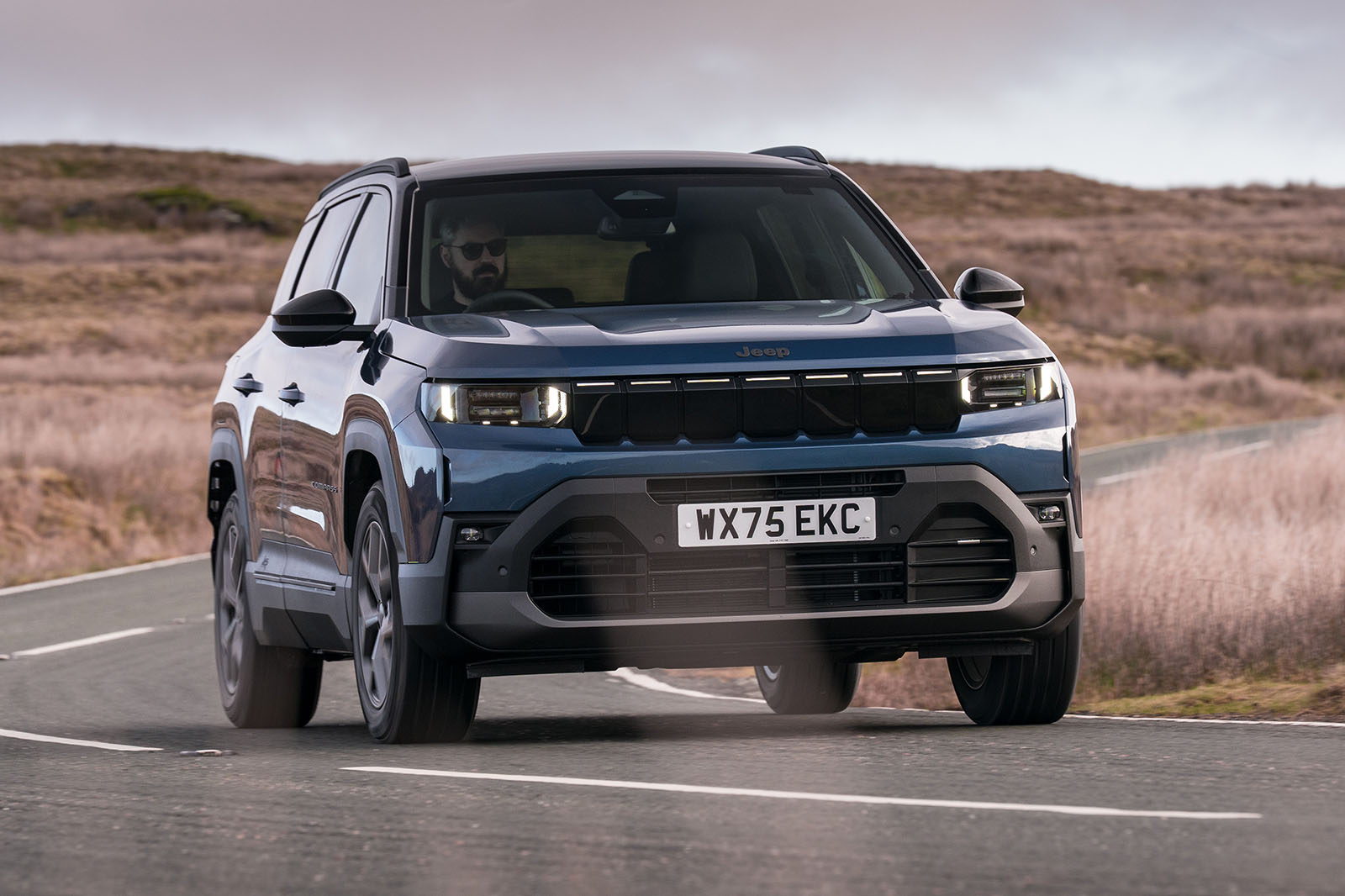
With quite lightly weighted and numb steering and only modest grip from its Michelin e-Primacy efficiency-biased road tyres, you’re disinclined to chuck the Compass into a corner with any enthusiasm - whether you're driving the e-Hybrid or the EV. But for slightly different reasons in each case.
The former has a ride that's a bit stiff-legged and wooden-feeling. Here, the Compass’s higher-speed body control is effective, but the suspension clunks and fusses over smaller, sharper inputs, and can jiggle the body around restlessly on country roads. It feels slightly over-firm and needlessly grabby with its damping.
The Standard Range EV, a little strangely, has the opposite problem. Some half-a-tonne heavier than the e-Hybrid, it struggles much more for steady body control and chassis composure on winding roads; though it has a better-isolated secondary ride (quite possibly thanks to independent rear suspension).
This is much too simple an explanation to be even remotely true. But it’s almost as if Jeep could only run to one suspension calibration for the Compass; and by splitting the difference between the two, it makes neither the e-Hybrid nor the EV feel fully settled on its springs.
MPG & RUNNING COSTS
6
Pros
e-Hybrid isn't bad value
Range and efficiency from the Standard Range EV is class-typical
Cons
EVs don't qualify for ECG subsidies, and look pricey as a result
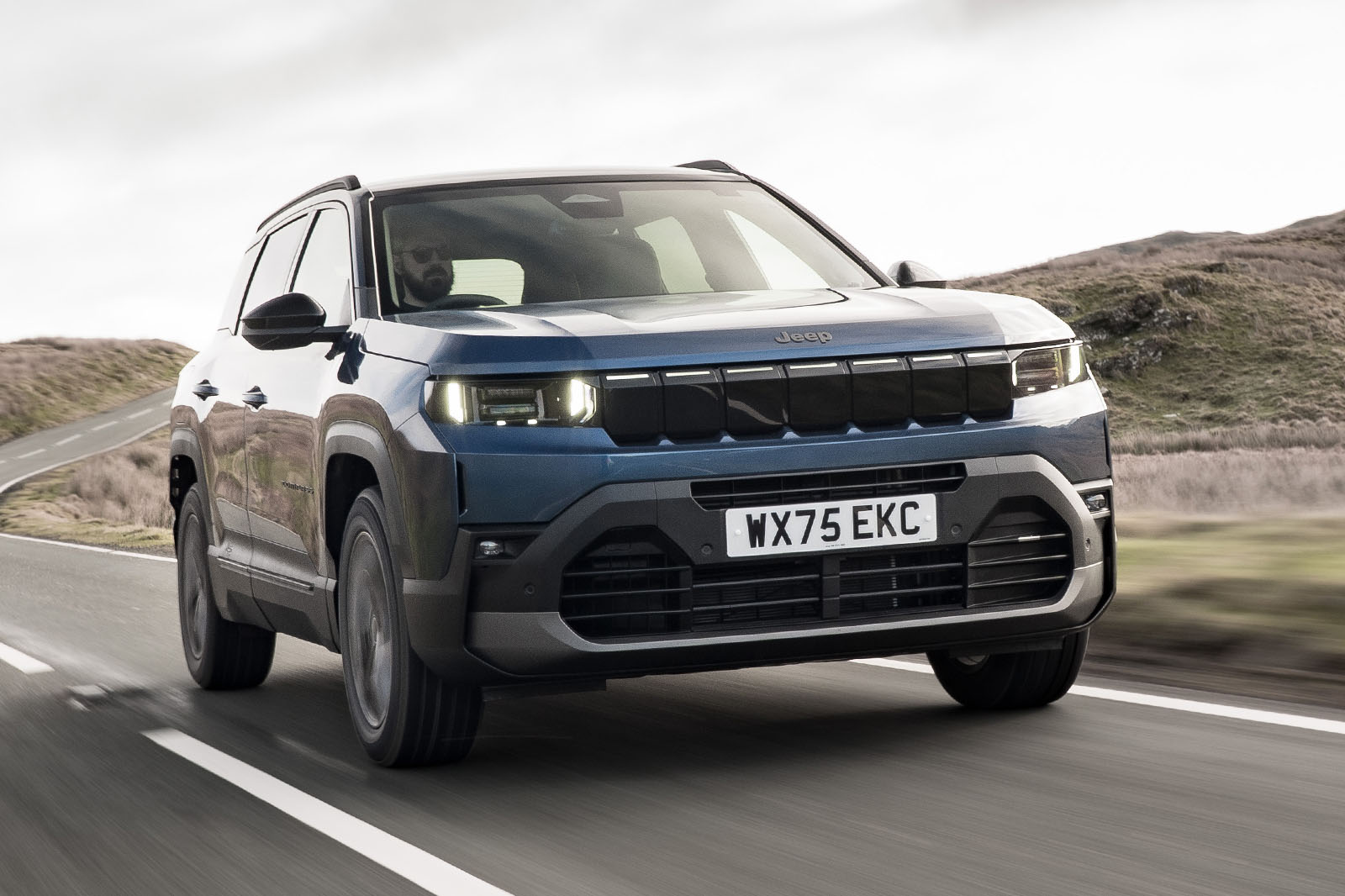
The entry-level Compass e-Hybrid is fairly reasonably priced, though it's quite a long way from a value proposition: with UK prices starting under £35,000. Hybrid options from rivals are typically more expensive; but then the 'light touch' technical makeup of the Stellantis 48-volt system tends to produce unspectacular fuel economy or a sort that's probably only slightly better than what you might get out of a 'micro hybrid' rival anyway.
The Compass EVs have a different problem, in that Jeep hasn't yet satisfied the SBTi's requirements to qualify for the UK government's Electric Car Grant; and that leaves them looking a little bit expensive, if only compared with some opponents. £37,000 is the departure point here; and you can get into a long range MG S5 from £32k, Skoda Elroq from £34k, Renault Scenic from £35.5k, and even a Vauxhall Grandland (with the very same powertrain) from £36k.
Real-world efficiency from the Standard Range EV is typically betwee 3.2- 3.5mpkWh; which means the 74kWh battery should be good for 230-260 miles. Pretty average stuff for the class and price.
The trip computer on my hybrid test car claimed it was using no fuel whatsoever. While that’s obviously a glitch, we know from experience that this powertrain can be reasonably efficient without setting new standards. Over the course of a week, the Peugeot 5008 returned mpg in the mid-40s. We’d expect similar from the Compass.
VERDICT
6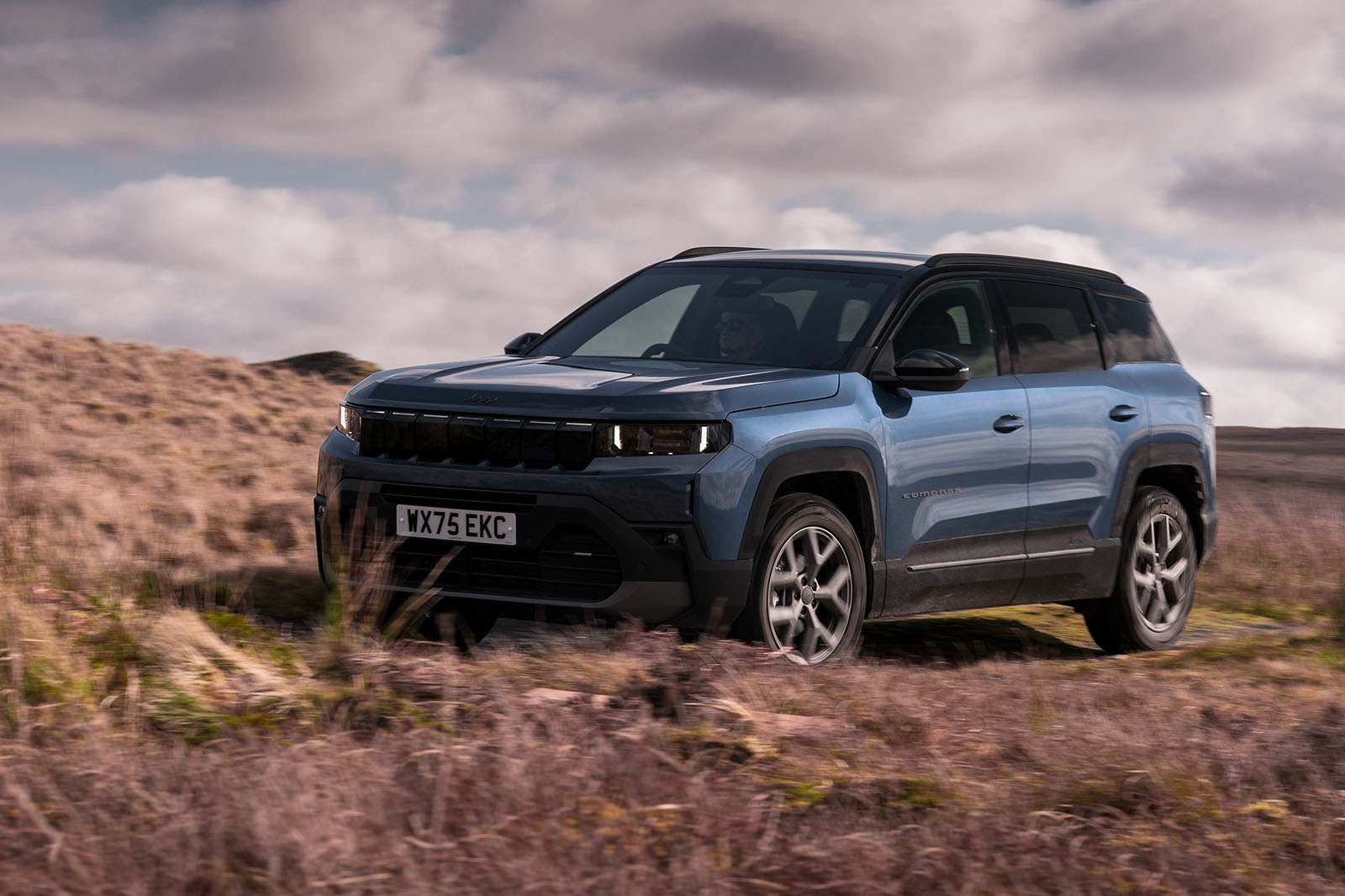
Verdict
Model tested:
Rating: 6
Jeep Compass
Smart looks, decent powertrains and a roomy boot make this a more sensible, competitive compact SUV than its predecessors; but also more forgettable than some of its siblings.
Good
Smart, Jeep-tough design appeal
Big boot
e-Hybrid model is decent value
Bad
Ride is variously flawed in both the e-Hybrid and EV
Second-row not as roomy or comfortable as rivals
EVs don't qualify for ECG support, so they're pricier than some
At under £35k, you can make a case for the entry-level Jeep Compass e-Hybrid as a functional, slightly roguish compact SUV; but the EVs will continue to look expensive for as long as they go without UK government ‘ECG’ subsidies, and don’t currently have either the dynamic qualities or the range and/or efficiency to back up the price.
That may change when the Long Range EV comes along. And the 4xe version may yet prove to have more Jeep-brand authenticity, of course.
That apart however, while the Compass is like a more respectable, credible compact SUV than its predecessors have been, and would meet the demands of everyday family life well enough - if you’ll bear another tawdry pun - it’s also seems like a car ill-prepared to press any one single selling point home.
TECHNICAL SPECS
Model tested:
- Jeep Compass e-Hybrid Altitude
- Price:
- £34,520
- Engine:
- 3 cyls inline, 1199cc, turbocharged, petrol; with 48v hybrid assist
- Transmission:
- 6-spd dual-clutch automatic; front-wheel drive
- Driveline layout:
- Front-transverse; front-wheel drive
- Model tested
- Jeep Compass e-Hybrid Altitude
- Price
- £34,520
- Engine
- 3 cyls inline, 1199cc, turbocharged, petrol; with 48v hybrid assist
- View all specs and rivals
- Transmission
- 6-spd dual-clutch automatic; front-wheel drive
- Driveline layout
- Front-transverse; front-wheel drive
- Power
- 144bhp at 5500rpm
- Torque
- 170lb ft at 1750rpm
- 0-62mph
- 10.0sec
- Top speed
- 121mph
- Kerb weight (DIN)
- 1667kg
- Fuel economy
- 48.7mpg
- CO2
- 131g/km
- BIK tax band
- 32%
- Rivals Renault Scenic E-Tech Kia Sportage Dacia Bigster
- Power
- 144bhp at 5500rpm
- Torque
- 170lb ft at 1750rpm
- 0-62mph
- 10.0sec
- Top speed
- 121mph
- Kerb weight (DIN)
- 1667kg
- Fuel economy
- 48.7mpg
- CO2
- 131g/km
- BIK tax band
- 32%
- Rivals Renault Scenic E-Tech Kia Sportage Dacia Bigster