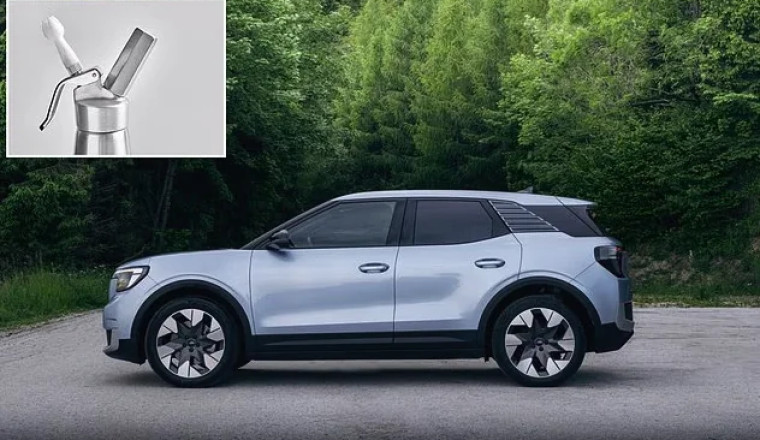

Ford has introduced a new centre side airbag system in its Explorer and Capri EVs that draws its technology directly from the pressurised gas canisters used to dispense whipped cream. The system uses cold gas inflation rather than the pyrotechnic charge found in conventional airbags, delivering the same millisecond deployment speeds without the extreme heat that traditional systems generate. The inspiration came when Ford's safety engineers began working with a supplier that had originally developed pressurised gas canisters for the food industry.
Christian Giesen, a vehicle safety engineer at Ford of Europe, told the Daily Mail:
"At Ford, we are always looking for creative solutions to make our vehicles even safer. This new centre side airbag is a perfect example of that ethos. By rethinking the technology, we were able to add a significant layer of protection for our customers. The fact that we found inspiration in a whipped cream can shows that great ideas can come from anywhere."
The significance of side impact protection is hard to overstate. When another vehicle hits you from the side, there is almost no crush zone between the impact point and your body. That compares to a frontal collision where you have an entire engine bay absorbing energy before forces reach the occupant. Side impacts account for between 35 and 40 per cent of all serious and fatal passenger injuries in the EU, and critically, almost half of those injuries happen on the far side of the vehicle from the actual point of impact. The Explorer's new airbag system specifically targets that problem, and it already contributed to the car earning a five star Euro NCAP safety rating in 2024.
The idea is older than most people think
The airbag has been saving lives for decades, but its origins stretch back further than the technology itself suggests. In spring 1952, a retired American industrial engineer named John W. Hetrick was out for a Sunday drive in Pennsylvania with his wife and seven year old daughter when he swerved to avoid a rock in the road. Nobody was hurt, but the near miss consumed him on the drive home. He spent that evening sketching a system he called a "safety cushion assembly for automotive vehicles," and filed for a patent on 5 August 1952. That patent, US No. 2,649,311, was granted on 18 August 1953 and represents the founding document of modern airbag technology.
Download on iOS | Download on Android
Hetrick had not come to the idea from nowhere. During his naval service he had watched compressed air accidentally fire a torpedo's canvas cover to the ceiling with startling force. He understood instinctively that a controlled version of that principle could protect people in crashes.
A German engineer named Walter Linderer filed a similar patent in 1951, but his compressed air design could not inflate quickly enough to be practical in the real world. Early research in the 1960s confirmed that any airbag system had to inflate in 40 milliseconds or less to be effective. Compressed air alone could not achieve that.
The breakthrough that made everything possible cost five dollars. In the late 1960s, New Jersey engineer Allen K. Breed invented the world's first electromechanical crash sensor, a ball in a tube held by a magnet that would break free on impact and trigger inflation. His design used sodium azide, a chemical compound that generates nitrogen gas almost instantaneously when ignited, and inflated an airbag in under 30 milliseconds. Breed marketed his system to Chrysler and effectively created the airbag industry. His crash sensing technology remains the conceptual basis for every system in use today.
From novelty to legal requirement
The timeline from patent to production was painfully slow. Ford built experimental airbag equipped vehicles in 1971 but they were never sold to the public. The first production car with a passenger airbag was the 1973 Oldsmobile Toronado. By 1974, Buick, Cadillac and Oldsmobile were offering dual airbags as an option on full sized models. Mercedes Benz brought the technology to Europe in 1980 as an option on the high end W126 S Class. The 1987 Porsche 944 Turbo became the first car anywhere to fit both driver and passenger airbags as standard.
The pivotal moment for mass adoption came in 1984 when the US government mandated either driver airbags or automatic seatbelts for all cars by 1989. By 1990, Ford had made driver airbags standard across its entire range. A congressional law requiring dual front airbags in every new US vehicle came into force in 1998, by which point airbags had already saved tens of thousands of lives. Between 1987 and 2017 alone, the NHTSA recorded more than 50,000 lives saved by frontal airbag systems.
There was a dark chapter. First generation airbags were calibrated to protect unbelted occupants, which meant they deployed with enormous force. Between 1990 and 2008, frontal airbags caused 290 passenger deaths in the US, 90 per cent of them children and infants. That led directly to second generation depowered systems and smart sensors that adjust deployment force based on occupant size and seating position.
The cockpit wrapped in fabric
The airbag that Hetrick sketched in 1952 was a single cushion emerging from the dashboard. A modern car bears almost no resemblance to that idea. The 2025 Ford Explorer carries front airbags for driver and passenger, a driver knee airbag, front seat side impact airbags, and Ford's Safety Canopy curtain system, a side curtain airbag that deploys across all three rows of seating in a rollover or side impact. Volvo introduced side airbags as far back as 1995 on the 850. Honda put the first airbag system on a production motorcycle in 2006, fitted to the Gold Wing. Some manufacturers now deploy airbags from the roof, the B pillar, the rear seats, and even the seatbelts themselves.
The centre side airbag that Ford has introduced in the Explorer and Capri EVs is specifically designed to protect occupants from hitting each other during a side collision, addressing a threat that early airbag pioneers never contemplated. It fills the gap between driver and front passenger, cushioning both from the lateral forces that a conventional side curtain does not address.
From a man watching a torpedo cover fly across a ceiling in wartime to an engineer looking at a whipped cream canister in a supplier's factory. Seventy years of incremental brilliance, and the cars around you are still getting safer.
Source: Daily Mail / MotorBuzz | Euro NCAP Ford Explorer 2024 datasheet | NHTSA airbag safety records | Consumer Affairs airbag history | Wikipedia airbag entry