

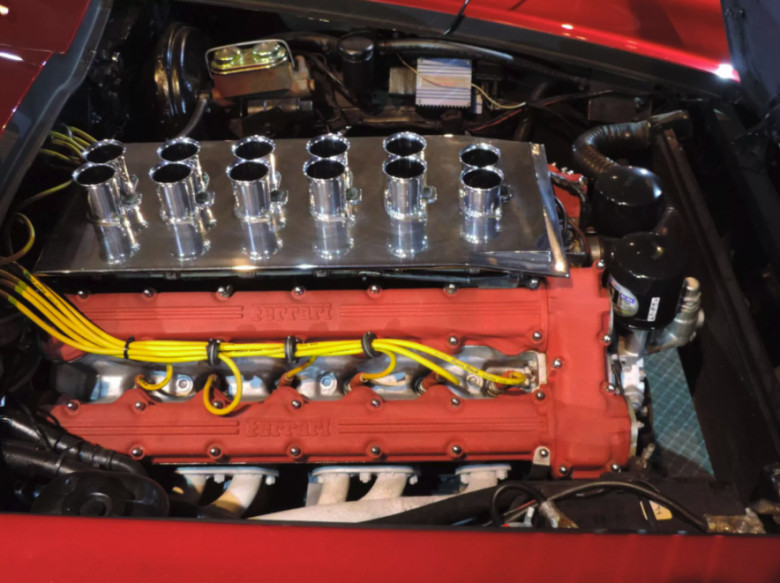
There’s muscle cars, and then there’s the Pontiac Firebird Pegasus, a 1970’s runaway masterpiece born from the bold imagination of GM’s legendary design VP, Bill Mitchell. What made this American beauty so special? Under its long, sleek Pontiac hood beat the unmistakable heart of Enzo Ferrari’s 4.4-liter Colombo V12 engine, famously found in the Ferrari 365 GTB/4 Daytona.
The story goes that Mitchell, enamored with a sketch blending Camaro flair and Ferrari finesse by Chevrolet stylist Jerry Palmer, swooped the concept to Pontiac before Chevrolet could claim it. Wanting a “high-revving, low torque Trans Am,” he convinced Ferrari to lend its motorsport heritage in the form of a 352-hp twin overhead cam V12 that screamed beyond 7,500 rpm. This was a muscle car with an Italian soul.
Engineering the Pegasus was a massive challenge. The engine’s length forced Pontiac engineers to push the firewall back nearly nine inches into the passenger footwell and craft custom mounts and exhaust headers to squeeze the quad-cam V12 into a chassis meant for a pushrod V8. They replaced the original transmission with a Ferrari five-speed manual to handle the engine’s fury, pairing European precision with American brute force.
Every component screamed quality and exclusivity: Corvette four-wheel discs, Borrani wire wheels, Ferrari mufflers, and an instrument panel borrowed straight from Maranello. The styling featured Italian curves coupled with Pontiac's aggressive stance, completed with grille and fender vents inspired by Ferrari headliners.
Dubbed sometimes the “Ferraribird” or “Uccello Di Fuoco” (Italian for “Firebird”). Sadly, the Pegasus never went into production, forever parking itself as a wild concept that bridged two worlds. For muscle car fans and europhiles it remains a beloved “what if” in automotive lore.