

The number that matters first is 0.75 seconds.
That is how much faster the new Ford Mustang Cobra Jet 2200 ran compared to Ford's own previous electric drag racing world record, which was set by the Cobra Jet 1800 just seven months ago in September 2024. In a sport measured in thousandths of a second, 0.75 seconds is not an improvement. It is a different category of machine.
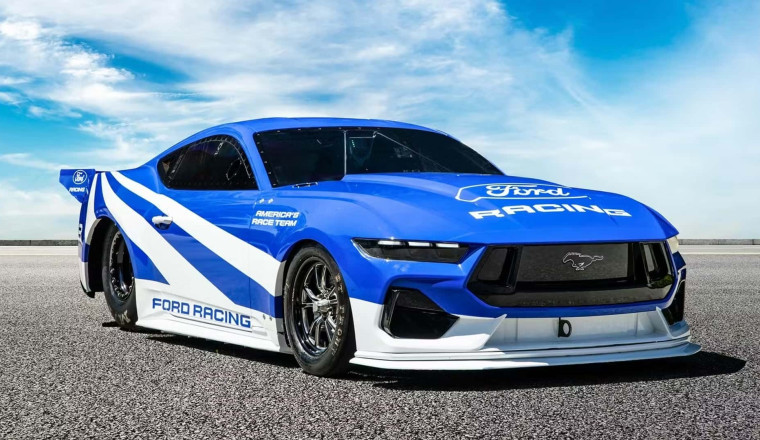
At the NHRA 4-Wide Nationals at zMax Dragway in Charlotte, North Carolina on April 25 2026, the Cobra Jet 2200 ran the quarter mile in 6.87 seconds at 221 miles per hour. Ford Racing confirmed it on X: "The Ford Racing Mustang Cobra Jet 2200 has clocked a new record time of 6.87 at 221 mph — now the quickest electric car on the planet."
Then, in a subsequent pass at the same event, it ran 6.81 seconds. The NHRA's own official report confirmed the weekend's best elapsed time was 6.766 seconds with a trap speed of 222.36 mph.
For context: the production Rimac Nevera R, with 2,107 horsepower and the title of the world's fastest production car down a quarter mile, runs 7.9 seconds. The Cobra Jet 2200 is a purpose built race car with no road counterpart — but the numbers are worth sitting with regardless.
What it actually is
The Cobra Jet 2200 is the third dedicated electric drag racer Ford has built in five years. The Cobra Jet 1400 ran 8.128 seconds in 2021. The Cobra Jet 1800 reached 7.623 seconds by September 2024. The 2200 is not a development of the 1800. It is a complete redesign.
The headline number is 2,200 horsepower from two purpose built electric motors paired with inverters operating at 98 percent efficiency. Each motor and inverter pair delivers approximately 1,100 horsepower. Compared to the previous generation, overall power is up by 600 horsepower while the motors and inverters weigh roughly half as much. The entire car weighs approximately 1,500kg, which is around 499kg lighter than the Cobra Jet 1800. That is not a marginal improvement. It is a complete rethinking of where the weight was coming from.
The electrical architecture runs on 900 volts. The battery system totals 32 kWh across modular packs — a large underfloor unit, two packs mounted at the rear, and an adjustable front battery whose position can be tuned for weight transfer depending on track conditions. According to Engadget, the pack charges in 20 minutes, comfortably inside the NHRA's mandatory 45 minute turnaround rule between rounds.
The clutch that should not exist in an EV
The most technically interesting feature of the Cobra Jet 2200 is one that sounds completely out of place in an electric vehicle: a centrifugal clutch.
In conventional drag racing wisdom, electric motors produce maximum torque instantly from standstill, which is precisely why they are so effective at launches. The problem is getting that torque to the wheels without spinning them into oblivion. The Cobra Jet 2200 uses a centrifugal clutch that slips momentarily at launch to manage traction, then locks up as speed builds to deliver the remaining power in direct drive at maximum efficiency.
The car also retains a gearbox with multiple speeds, because electric motors produce their peak power at higher rotational speeds. A single ratio setup would leave the car operating outside its optimal power band for a significant portion of the run. Electrek reports that Ford credits the transmission alone with adding more than a second of performance potential over a single ratio design. Ford's own safety engineers also developed a pyrotechnic circuit breaker for the car, a small explosive charge capable of severing the high voltage connection instantly in an emergency — a technology designed in consultation with NHRA safety protocols.
Like this? Get the app: iOS | Android
The five year progression
2021: Cobra Jet 1400. Quarter mile in 8.128 seconds. 2024: Cobra Jet 1800. 7.623 seconds. 2026: Cobra Jet 2200. 6.766 seconds.
That is 1.36 seconds stripped from the electric drag racing record in five years — an improvement at a pace that combustion engined drag racing did not approach across its entire modern development arc. Carscoops notes that Ford's engineers credited extensive simulation work for how quickly the 2200 found its performance on minimal real world testing, with the car producing consistent 6.87 to 6.86 second passes almost immediately.
The irony hanging over all of this is noted in almost every coverage of the record: Ford's consumer EV division is in significant difficulty. The Mustang Mach-E has been repositioned and repriced multiple times. The F-150 Lightning discontinued the standard range model due to low demand. Ford's EV chief departed in early 2026. The company is refocusing its electric vehicle strategy on models under $40,000.
Meanwhile, Ford Racing is setting world records with electric drag cars.
The technologies are not entirely disconnected. The Cobra Jet 2200's 900-volt architecture and 98 percent efficient inverters represent genuine engineering advances. Whether any of it finds its way into a car an ordinary person can buy is a question Ford has not answered. What it has answered, at zMax Dragway at 221 miles per hour in 6.87 seconds, is what is possible when the engineering is allowed to run unconstrained.
Sources:
- NHRA Official — Mustang Cobra Jet 2200 becomes quickest and fastest electric car in quarter-mile
- Electrek — Ford's 2,200-HP electric Mustang runs 6.87-sec quarter mile, smashes EV record
- Carscoops — A 2,200 HP Mustang Silently Outran Every V8 Cobra Jet Ford Has Ever Built
- Engadget — Ford's Mustang Cobra Jet sets a new EV quarter mile record at 6.87 seconds
- American Cars and Racing — The Ford Mustang Cobra Jet 2200 Just Set A Quarter-Mile Record
- Ford Racing via X — April 25 2026