
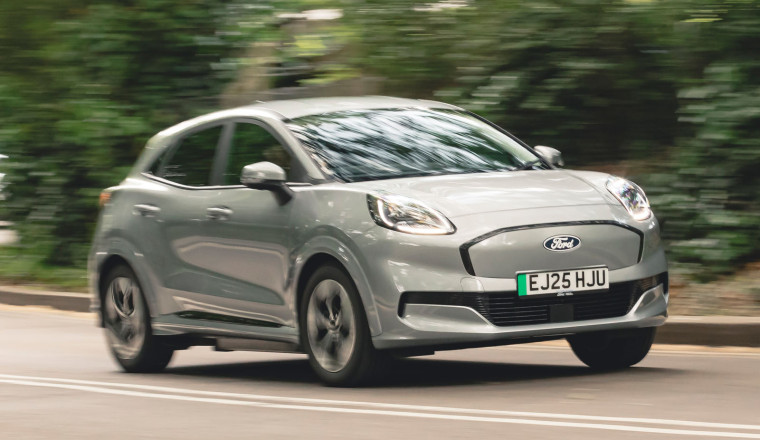

Ford has become the strongest voice so far among UK car companies in calling for the government to follow the European Union (EU) in softening electric car targets.
The majority, along with their representative body, the Society of Motor Manufacturers and Traders (SMMT), have either been more muted or declined to comment when approached by Autocar.
Green groups and EV-focused companies meanwhile argued that the UK should stay the course and stick to its target to end sales of new ICE cars by 2035.
“Following the EU ruling, it is clearer than ever that the UK needs to follow suit and urgently close the gap between our ambitious targets and market realities,” Ford UK managing director Lisa Brankin said. “Bringing forward the VETS [ZEV mandate] review immediately is the first step to deliver this.”
The European Commission on Tuesday proposed to amend the total ban on new ICE cars that was due to come into force from 2035, requiring car makers to reduce emissions by 90% from 2021 levels by that date instead of 100%.
The UK has one of the toughest timetables for electrification, with the ZEV mandate legislating a higher percentage of EV sales each year up to 2035 and all cars required to be hybridised in some way from 2030.
The car industry has strongly criticised the ZEV mandate in the past, but recent moves by the government have eased some of their concerns.
“The UK needs to do what is right for its own transition,” SMMT CEO Mike Hawes told Autocar in a statement.
However, he added that “Europe is the biggest market for UK automotive exports and the largest source of products for UK car buyers, so what happens in Europe matters to the UK".
The government said back in 2023 that it would publish a ZEV mandate review in 2027. However, industry minister Chris McDonald told the Financial Times on 16 December that the process would start next year, suggesting Ford’s appeal for a faster decision could be possible.
The Department of Transport’s official statement is that the government is committed to phasing all ICE cars and vans out of the market by 2035.
The review could change that and put the UK on the same trajectory as the EU in allowing a portion of sales from ICE vehicles or at least ease the route to full electrification.
“The review must consider all aspects of the transition, including demand, infrastructure, fiscal incentives and the global context, given the UK sector does not operate in isolation,” said Hawes.
Volkswagen UK called for a speedy analysis of the impact of the ZEV mandate but stopped short of an outright demand that the UK follow the new EU proposals. “We have been calling for a review of the UK regulatory framework based on market data for some time,” a spokesperson told Autocar.
However, the company suggested that the right solution is continued government support for the growing of EV sales, rather than delaying the shift to full electrification. “We now have over 20 BEVs in the market from which customers can choose. Continuity for a BEV ramp-up is important,” the spokesperson said.
German car makers have applied some of the strongest pressure on the European Commission to push back the 2035 date after struggling to reach its own optimistic EV sales targets.
Stellantis meanwhile has been critical of the EU’s proposed changes to the legislation. “The proposals do not meaningfully address the issues that the industry is facing right now,” the company said in a statement, highlighting weaker-than-expected rewrites to van emissions rules in particular. It said in the UK that it would “welcome a review in its approach to its steeply mandated targets and to do so early in 2026”.
The proposed changes for the EU could theoretically mean that 50% of all cars sold there after 2035 could contain a combustion engine, provided they're fitted to range-extender EVs, according to data from Brussels-based lobby group Transport & Environment (T&E). That falls to around 5% if the models have a high-consumption combustion engine only.
T&E has urged the UK not to follow the EU with its changes. “The UK should actually double down and aim to be a leader for electrification,” said its director of cars, Lucien Mathieu.
EV-focused companies also voiced their concern about potential rule changes, as these would potentially hurt their investment plans. Fiona Howarth, head of EV leasing firm Octopus EV, said in a statement: “Diluting the UK’s ambition in response to changes in Brussels would send a damaging signal to investors, manufacturers and supply-chain partners, many of whom have already committed significant capital on the assumption that the UK would stay the course."
The current government strategy is to help the transition by incentivising EV sales through the Electric Car Grant. It provides discounts of £3750 to manufacturers of EVs either assembled in the UK or with strong UK connections. Examples include the Nissan Leaf, which has started production in Sunderland using a battery built on site by Chinese firm AESC.
The UK maintaining its target while the EU softens its approach could encourage more Chinese automotive investment in the UK, argued automotive industry veteran Andy Palmer. “If you want to kill an industry, follow the EU playbook,” the battery-focused entrepreneur wrote for Politics.co.uk. “The alternative is for the UK to hold its 2030 and 2035 commitments and position itself as a European laboratory for EV adoption. In return for low barriers to entry, it would follow the model of Thatcher’s Britain in the 1980s and China in the 2000s, actively collaborating with China.”

Kia appoints new European CEO
Kia appoints new European CEO
Ford leads push for UK to follow EU on electric car rollback
Ford leads push for UK to follow EU on electric car rollback
Kangoo small van has long been a big hit for RenaultFord hopes Renault deal can plug its weakness in small vans Ford hopes Renault deal can plug its weakness in small vans
Ouass (left) and Rahn (right) are the managing partners of the Halo Cars GroupFirst T50 buyer behind £90m funding for Gordon Murray Automotive First T50 buyer behind £90m funding for Gordon Murray Automotive
Ford takes £14.5bn hit as it rethinks global EV plan
Ford takes £14.5bn hit as it rethinks global EV plan
To access this content please subscribe
Kia PV5
8 Kia PV5
Leapmotor B10
Leapmotor B10
Kia EV5
7 Kia EV5
Chery Tiggo 9
Chery Tiggo 9
Renault Clio
Renault Clio
Haymarket Media Group, publishers of Autocar Business, takes your privacy seriously. Our Automotive B2B brands and partners would like to keep you updated by email, phone and SMS with information and opportunities relevant to your work. Click here if you do not wish to receive these messages.
I DON'T want messages from Autocar Business, other Automotive B2B brands or from you on behalf of your trusted partners via the following channels: