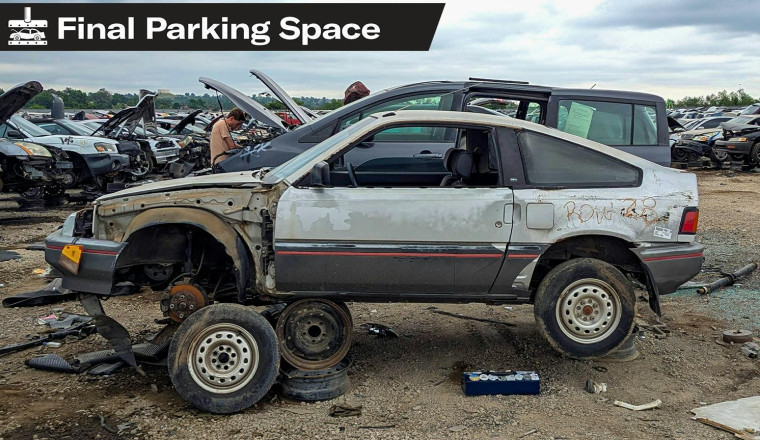

We’ve seen a good cross-section of Toyotas, Subarus, and Nissans in this series, and even a Mazda and a Mitsubishi. Now it’s time to add more to the story of Japanese iron in North America by documenting some cars made by Soichiro Honda‘s company. We saw a first-year Acura (Honda) Legend a few weeks ago, and now I’ve found a discarded example of one of the most iconic Hondas of the 1980s: a first-generation CRX.
The Honda Motor Company got its start as the Honda Technical Research Institute, building motorized bicycles in the rubble of Tokyo in 1946. Production of proper motorcycles began in 1955, and the biggest sales hit Honda has ever had arrived in 1958: the Super Cub. With well over 100 million sold since then, the Honda Super Cub is the most-produced motor vehicle in human history (the most-produced mechanized vehicle of any sort is the Flying Pigeon bicycle).
Honda was thus a motorcycle company at heart, and it stayed that way for many decades. Its first cars used motorcycle-derived powertrains, and even the Hondamatic sort-of-automatic transmission was developed originally for use in two-wheelers. The first Civic was developed using lessons learned from the motorcycle-adjacent N360 kei car (it was sold as the big-block N600 on our side of the Pacific), and the Honda philosophy of bolting high-revving engines into lightweight chassis was still with the Civic when the third generation went into production in 1983.
The third-generation Civic first appeared in North America as a 1984 model, and it was such a smash sales hit that some American Honda dealers resorted to skullduggery in order to siphon off inventory meant for their rivals.
A two-seat hatchback version called the Ballade Sports CR-X was created for the home market. In North America, this car was sold as the Civic CRX.
Just as Toyota ended up excising the Celica name from the Supra after a while, Honda ditched the Civic name from the North American CRX for the 1988-1991 second generation. The 1984-1987 CRXs had factory Civic badging here.
In true Honda fashion (that is, true Honda fashion while Soichiro was still alive), the original CRX managed to be both an ultra-stingy econo-commuter and a lot of fun to drive. This car scaled in at a flyweight 1716 pounds.
Every production CRX ever built got outstanding fuel economy, but this one is the model designed specifically for gas sipping: the HF. The EPA rated it at 52 miles per gallon in the city and 57 mpg on the highway. Even the miserably slow Chevrolet Sprint ER (aka first-generation Suzuki Cultus) couldn’t beat that.
The HF was quick (or at least nimble) enough to be fun, with its 58-horsepower 1.5-liter SOHC engine. The regular CRX had 76 horsepower and the hot-rod CRX Si had 91 horses for the 1987 model year.
During the mid-1990s through early 2000s, I owned a series of first-gen CRXs (unfortunately, that was the film-camera era and my only photos of any of those cars are of a head-gasket job I did on a police-auction ’85). I loved driving those cars, and I got honest high-40s freeway mpg in non-HFs.
The reason I stopped driving 1984-1987 CRXs is simple: the non-Si models used carbureted CVCC engines, and the tangle of vacuum lines, solenoids, sensors, and incomprehensible underhood boxes packed with mysterious hardware needed to make the CVCC engine meet emissions standards got so complex by the middle 1980s that the diagram is known as The Map of the Universe.
The system worked very well in terms of driving quality and reliability, but I lived in California at the time and the state BAR tightened emissions-testing standards around the turn of the century. Suddenly, a tiny vacuum leak or sticky valve somewhere in the Map of the Universe would make my car just barely fail its smog check. I tried to chase down and repair the problems (Honda was kind enough to print numbers on the vacuum hoses), but… forget it. I moved on to daily drivers with electronic fuel injection.
This car never quite reached 200,000 miles during its career. The highest-mile junkyard CRX I’ve documented had 413,443 miles on the clock.
It sat immobile outdoors for a long time, maybe decades, before arriving here.
The paint got nuked hard by the harsh High Plains Colorado sun.
The interior is dirty but not abused.
These cars have enough of an enthusiast following that I’m surprised this one ended up here. I find a few 1988-1991 CRXs in the local boneyards but most of the 1984-1987 models seem to get diverted on their way to the junkyard.
The CRX’s successor was the Civic del Sol, which first arrived in the United States as a 1993 model (the junked example in the photo above is one of the first few hundred imported). It was a well-built car but proved less lovable than the CRX.
“Honda will again be leading the industry!” Which wasn’t wrong; the CRX outsold other affordable two-seaters such as the Ford EXP/Mercury LN7, Bertone X1/9, and Toyota MR2.
The home-market commercials got CR-X theme songs.
Design evolution of Saab Sonett then Alfa/Zagato Junior Z.
These were great cars with great fuel economy. Not the sportiest thing but not bad for the time.
Had a 95 CRX Si for a minute and it was one of the best cars I’ve owned. Great gas mileage and had enough “oomph” to get around. I have a picture of it behind my 72 Chrysler New Yorker Brougham and the CRX looks like it could the Chrysler’s lifeboat ?