

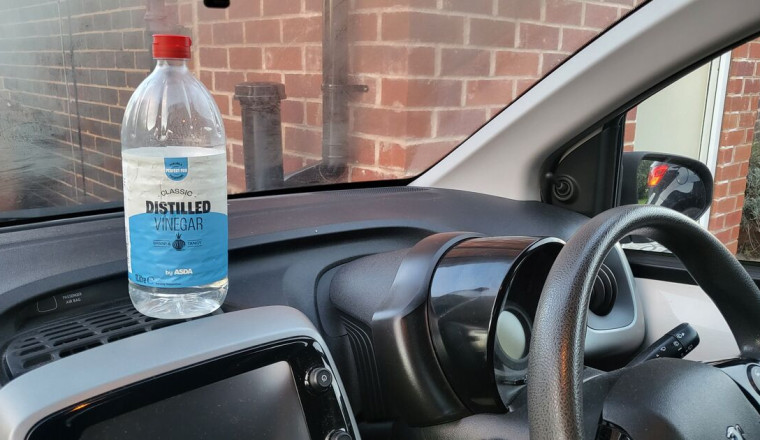

Drivers across the UK are urged to put white vinegar in their cars from Thursday to prevent condensation. Despite a relatively mild start to March, the weather is forecast to take a turn for the worse later this week, bringing rain and wintry conditions to parts of the UK. The Met Office said the change in the weather will begin from Thursday, March 12, with brisk winds and heavy rain on the cards for many areas, plus a chance of snow on Scottish mountains. Temperatures are forecast to turn colder from Friday with "wintry hazards", including heavy showers, coastal gales and snow over higher ground, as well as accumulations at lower levels.
Met Office weather maps show snowfall from Thursday evening into Friday for parts of Scotland, Northern Ireland, North West England and North East England, while some snow covers parts of North Wales, North West England and West Midlands in the early hours of Saturday morning. Jason Kelly, Chief Operational Meteorologist for the Met Office said: “A notable shift in wind direction to a north-westerly flow will bring a markedly colder day nationwide on Friday, with the potential for a mixture of sunny spells, heavy showers, coastal gales, and snow over high ground.
"There’s also the possibility of accumulations on lower hills too. The picture will become clearer closer to the time, so keep an eye on our forecast as the week progresses”
The wintry weather means drivers will be battling with condensation and fogging in cars this week as temperatures plummet, which can take a frustrating amount of time to clear - but experts say the problem can be easily tackled with the help of some white vinegar.
Condensation forms when warm air inside a car meets the cold surface of the glass windows, causing water droplets to form as the air cools, which can appear as fog or mist, and this is typically more pronounced during bouts of cold weather.
The colder the outside temperature is, the more dramatic the temperature drop when warm air hits the glass, which leads to fogging. Fogging can take a frustrating amount of time to clear, but there is a cheap and simple solution you can use to tackle the problem – and all you need is some white vinegar.
But according to experts, spraying windows with a solution of white vinegar and water creates a protective barrier that prevents moisture from settling and thereby reduces condensation.
You can pick up a 568ml bottle of white vinegar for just 35p at Tesco and Aldi so it’s a cheap solution to the problem and it will also clean your windows in the process, but it will need to be reapplied frequently throughout the winter.
Experts at Loco Windows Fascias said: "A home-made solution is a great way to deal with condensation on windows. You will need a mixture of two cups of white vinegar and two cups of water.
"You can use a spray bottle to apply the solution to the window or you can simply wipe it on. Then let it dry with a soft cloth."
To increase the effectiveness of the solution, some experts recommend adding a few drops of washing up liquid to the mix as this reduces the surface tension of the water on your window, causing moisture to instead spread into a thin, invisible layer rather than forming droplets.

Experts at Cardiff Window Cleaner Ltd explain: "A great way to clear away condensation and prevent it from coming back is by mixing a homemade solution.
"Simply mix two cups of water and two cups of white vinegar, then add a couple of drops of dishwashing soap. Pour this mixture into a spray bottle and spray it straight onto your window.
"White vinegar creates a protective barrier, and soap breaks down the surface tension of the droplets on your window. We suggest using a spray bottle to create a very thin protective cover, which will dry up by itself."
Failure to clear condensation from your windscreen before setting off could result in a £1,000 fine and three penalty points on your licence, so it’s important to tackle the problem and using white vinegar is a really cheap way to do it.