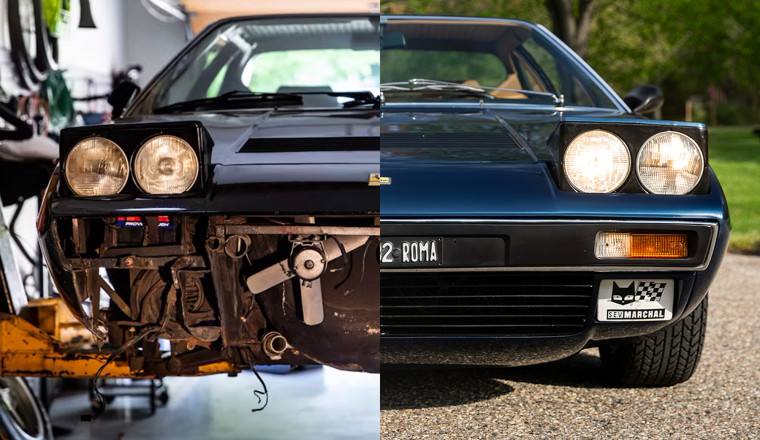

The Ferrari decided that I needed another lesson in how automotive ignitions work. That’s an odd sentence to write about a car, but after 48 months of bringing a once-slumbering 1975 Ferrari Dino 308 GT4 back to life, I began to wonder what sort of cosmic forces were in play between this machine and me.
If you’ve read any of my previous reports about my one-step-forward, three-steps-back restoration project, you’ve probably gleaned that I’m not a patient man, but I eventually learned to roll with the punches. Which included not one, but two engine rebuilds and the demise of not one, but two artisans who were working on the car. Now, finally, the Dino is done, or done enough for me to share what you’ve probably been wondering: How much money did that fool Webster spend on this thing?
When I stood at the workbench in my garage and totaled up the receipts, I gasped at the sum. I might even have clasped at my heart. Nothing to be done but open the garage door, back out the Dino, and take it for a quick spin to remind myself that it was all worth it. One mile from my driveway, the engine sputtered and backfired. For chrissakes, what now?!
My understanding of how the ignition system delivers the right voltage to the right spark plug at the right time amounted to knowing where the wires connected. That’s hardly enough to do what real mechanics do, which is observe a problem, form theories about the issue, and then prove or disprove the theories until they identify the root cause. Forced to dig deeper, I actually read, instead of skimmed, various manuals; consulted with experts; and watched several YouTube videos. Freshly educated, I concluded that the crusty old Magneti Marelli coils were limping at best. I replaced both, adding another $600 to the ledger, reset the timing, and climbed back behind the wheel. A small but significant victory.
***
Restorations and project cars are ventures into the unknown and require an amount of naive optimism. There was plenty of that when I bought the GT4 for $25,000 in January 2021. I sought not just the car, but the benefits derived from a DIY effort supplemented by paint and body-work experts. I enjoy learning new things while consulting with pros, and projects are always fantastic conversation starters. I also hoped to pass along some lessons about problem solving and perseverance to my kids, whom I enlisted to help. We knew there’d be setbacks and maybe a calamity or two, but that’s what childhood memories are made of.
I had tackled a similar project with a 1969 Porsche 911, purchased in 2016, so I figured I had a decent track record. The Porsche took about a year and $50,000 to go from barn find to cherished back-road runner. I knew the right folks to handle paint and body work. Bring that Ferrari into the garage, boys!
What was I just saying about naivete? No sooner had I disassembled the entire car than my estimated punch list quickly ballooned, starting with an unplanned engine rebuild. With the car already lying in pieces on my garage floor, why not make sure everything was fresh? The rebuild alone cost 20 grand, which I’ve since learned isn’t a bad price for a motor from Maranello. A new interior cost another $17,000 and the paint was 16 large. Subtotal so far: $53,000.
Interestingly, the parts bill wasn’t as bad as I expected it would be, totaling about $13,000 including the new coils. Miscellaneous parts and labor like tires, oil hoses, and powder-coating the suspension sucked another 10 grand out of my wallet. I even had the shocks and brake calipers professionally refreshed. Perhaps you remember the yearlong saga of the steering-column switches, which I’d sent out east to be rebuilt, a $1000 service. After a year of no action from that specialist, I dispatched Hagerty columnist Rob Siegel, who lived nearby, to the man’s house to rescue my switches.
To be sure, waiting for professionals to get around to their tasks was the hardest part for me, a Type A engineer who is accustomed to precise planning and execution. I initially employed a shop to refurbish both the body and the interior and sent the car minus the powertrain. They asked for $5000 up front and since I’d worked with them before, I paid it. Dumb. They took the interior apart and then the car sat for more than six months while the painter, whom I knew, badgered me that he wanted to start working on the car. Calls to get it moving resulted in a request for another five grand. I asked to be billed after the fact, a reasonable request given my down payment and my history with previous projects. “Come get your car,” was the reply. A wasted year.
I shared that episode with the next painter and explained I could not stomach the car languishing in body-shop jail. “No problem!” he replied, but then his paint booth caught fire just as I delivered the Dino to his shop. Ten months later, I started hounding him—nervously, since I didn’t want a rush job. But when would it be finished? I got it back a couple of months later. For at least two of the four years I’ve owned it, the car sat in someone else’s shop. Somewhere along the way, I lost the Dino’s sun visors.
Then there were the tragic deaths. The first painter, one I’d worked with numerous times and considered a friend, died while he had the car. There were no records of the time he had spent stripping the paint and fixing the rust, so I wrote his widow a check for $3000. After I’d paid the second interior trimmer $5000, he also died suddenly. At this point, I began to wonder if anyone who laid their hands on the car would be cursed. My wife declared she, for one, would never ride in it.
***
My restoration costs were $90,000, including about $13,000 for work that was never completed due to unforeseen and unfortunate circumstances. The total was nearly double my optimistic projections, so I’ve spent about $115,000 on a car that the Hagerty Price Guide pegs between $75K and $100K. Over the past four years, though, I’ve had an adventure. Sure, there were headaches that made for compelling dispatches—which I do hope you’ve enjoyed, haha—but there were far more positive experiences than negative.
As I write this, spring has arrived in Michigan. As I sink into the Dino’s caramel-colored seats and giddily head out onto country roads, I reflect on the happier times of my 1500-day adventure. Such as when the fresh engine burned oil like an insect fogger and Al Pinkowsky, proprietor of GT Motorsports in Milwaukee, immediately took it back and dove right in. He found poor-quality piston rings, an issue he had never seen in his decades of working on Ferraris. There was no charge for the second rebuild, and I got to spend a day working alongside Pinkowsky to reinstall the engine, a supreme learning opportunity.
The good vibes continued in Waterford, Michigan, where the guys at Munk’s Motors gave me an estimate for the interior, stuck to it, and delivered the car in a timely fashion. A local windshield expert installed the chrome windshield trim and wouldn’t take any money because he had heard about my troubles. Nice.
I had my own gratifying shop moments: finding a tiny nick in the fuel-pump wire that was causing it to intermittently shut off; getting the power windows to glide in their tracks. During this time, I called Luigi Chinetti Jr., who operated Ferrari dealerships with his father, noted U.S. importer Luigi Chinetti. The elder Chinetti provided a critical early income stream to Enzo Ferrari. I was curious to know what an insider like Chinetti thought about the Dino, a controversial car in 1975.
My Dino was preceded by the coveted Dino 206 and 246, which arrived in 1968. Enzo Ferrari used his deceased son’s nickname—Dino—for racing cars and then applied the moniker to a street-car sub-brand. The first Dino road car wore a voluptuously curved body penned by Pininfarina, Ferrari’s long-serving design house. A V-6 reportedly designed in part by Enzo’s son and with F1 lineage filled the rear engine bay.
The second Dino, the 308 GT4, included small rear seats and a new V-8. For the first time, Ferrari did not employ Pininfarina for the body, but rather Bertone, another famous Italian design company. Although the wedge shape was drawn by Marcello Gandini, who had done the Lamborghini Miura and many other stunning cars while employed at Bertone, the 308 GT4 was and is considered the ugly duckling Ferrari. I asked Chinetti Jr. what he and his dad thought when they saw it for the first time. “I looked at my father,” he remembered, “and said, ‘It’s time to sell the dealership.’”
I laughed, enjoying the anecdote about a car design that I find captivating, especially now that my example is painted in my favorite color, Blu Sera.
Back to my ignition problem. Since I was replacing the coils, I thought I should also replace the condensers, so I called David North, who runs Marelli Distributor services and who had already rebuilt the distributors. After listening to my latest tale of woe, North referred me to Stephan Markowski, a professional mechanic who has tuned many GT4s. During a half-hour phone call, Markowski explained his personal procedure for adjusting and synchronizing the four Weber carburetors. I grew up with fuel injection, so those passive fuel-delivery devices are mechanical mysteries to me.
I’ve had plenty of mechanical coaching in my time, but for whatever reason, Markowski’s words clicked. “If it takes five days to get it right,” he admonished, “it takes five days. And when they’re tuned right,” he added, “those engines will smoothly pull from 2000 rpm to redline.”
The carbs were a turning point. After four years of tinkering, the light bulbs finally went on and I understood how everything worked so I could form my own theories about what might be wrong. New coils wired and carbs tuned, I backed out of my driveway with my son in the passenger seat. He laughed, reminding me that the last time he was in the car, it died two blocks away, and a pizza-delivery guy helped us push it off the road. But instead of the dread I’d felt about this car, the fear that something else would fail, I felt oddly at ease. If the engine didn’t run right, I had a list of things to try. Remember, I told myself, you’re doing this for the process as much as the result. I’ve got far more skin in this car than if I’d just bought it.
I whooped when the engine sang a proper song. There it was, the crisp response Markowski had promised. In about five miles, I remembered why I had searched for a Dino for more than a decade: the uncommon combination of communicative steering, sharp response, and gutsy V-8. After about 10 miles, I noticed a slight stumble under 3000 rpm and knew the next thing to try was larger idle jets. I got this, I told myself. We made our way home. My son climbed out of the passenger seat, but I told him I was going to head back out on the road. I missed dinner that night.
This story first appeared in the July/August 2025 issue of Hagerty Drivers Club magazine. Join the club to receive our award-winning magazine and enjoy insider access to automotive events, discounts, roadside assistance, and more.