

By FREDA LEWIS-STEMPEL, MOTORING REPORTER
A lack of funding for local councils is the single biggest barrier to installing more public electric vehicle charge points, new research has found.
Out of eight barriers to EV charging rollout, constrained budgets and slow access to government funding are the largest hindrances to more charge points being installed.
Seventy-five per cent of the 101 local authorities surveyed across England, Wales and Scotland, by charge point operator (CPO) Believ said that pressure on council budgets is their main obstacles to expanding public EV charging.
Nearly two-thirds say central government funding is a barrier too, while 42 per cent say logistical and delivery challenges are problematic too.
The findings come despite the UK charging network's growth, with nearly 88,000 charge points installed across 45,000 locations.
Local authority-led deployment continues to play a crucial role in the growth of the network and is crucial to ensuring coverage in residential areas, small towns and rural communities.
75% of the 101 local authorities surveyed across England, Wales and Scotland by charge point operator (CPO) Believ said that pressure on council budgets is their main barrier
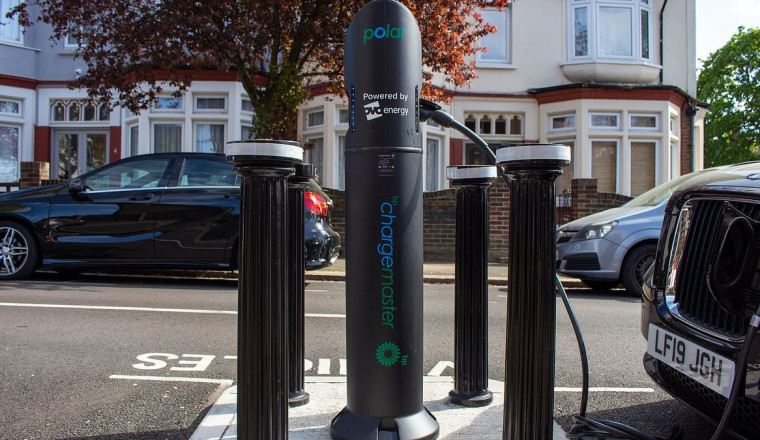
Local EV public charging is essential for drivers with no driveways or means to privately charge their electric cars.
So, while network growth statistics look good on the surface, progress is however threatened by complex funding processes, administrative delays and infrastructure constraints.
Believ's 'Accelerating the UK's EV future' Authority Insight Report indentified eight main barriers, ranked as follows: Budgetary issues (council budgets), budgetary issues (government funding), logistical/delivery challenges, low EV ownership/local demand, public sector procurement challenges, lack of siting guidance, regulatory constraints and resident reticience.
After the top three issues, low EV ownership/demand was cited as a challenge by 31 per cent of local authorities, while procurement challenges were cited by 17 per cent, and lack of siting guidance followed just behind on 16 per cent.
Regulatory constraints are a problem according to 12 per cent of local authorities while resident reticence is a barrier cited by 11 per cent of councils.
Overwhelmingly 71 per cent of councils said that they would prefer a more direct and targeted access to Local Electric Vehicle (LEVI) funding.
This goes up to 78 per cent amongst rural and semi-rural councils. 43 per cent want greater local say in budget decisions.
71% of councils said that they would prefer a more direct and targeted access to funds Local Electric Vehicle (LEVI) funding. This goes up to 78% amongst rural and semi-rural councils

Because resourcing was cited as a key reason causing local council budget pressures, local authorities will be eagerly anticipating the rollout of the government's £200 million additional capability funding, announced in the Budget, that will fund more dedicated EV Councillors.
Encouragingly, three-quarters of UK councils now have formal EV charging plans, up from two-thirds in Believ's previous insight report.
And the majority have issued or are about to issue tenders to charge point operators.
With numerous LEVI contracts now signed with CPOs, the hope is that 2026 will see a significant uplift in the LEVI charge point rollout.
Only 12 per cent of local authorities do not expect to complete their planned rollout by 2030.
Guy Bartlett, Believ CEO: 'The clear and urgent priorities of unlocking funding, streamlining processes, expanding and signposting guidance must be addressed.
'The responsibility for this lies in tandem with the charging industry and government – with the right partnerships, the UK can build an EV charging network that works for everyone.'
The total number added last year to 14,097, according to industry group Zapmap - this is down 30% on 2024
Only 628 public chargers were installed in December, taking the total number added last year to 14,097, according to industry group Zapmap.
That was down nearly 30 per cent on the 19,834 installed in 2024 and more than 2,500 fewer than in 2023.
The figures fall behind Labour's target of having 300,000 public charging points installed by 2030.
Experts warned a shortage of charge points will fuel 'range anxiety' and cause drivers to lose faith in the green transition.
Ginny Buckley, chief executive of electric vehicle (EV) buying and advice site Electrifying.com, said: 'A lack of reliable charging in northern cities directly undermines confidence in EV driving. This is a real North–South divide.
'When one London borough has more chargers than five major northern cities combined, it sends a clear signal to drivers outside the South that the system isn't working for them.'