

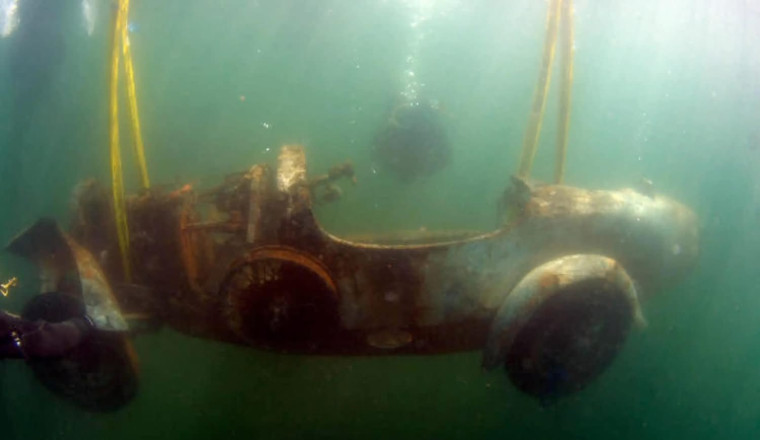

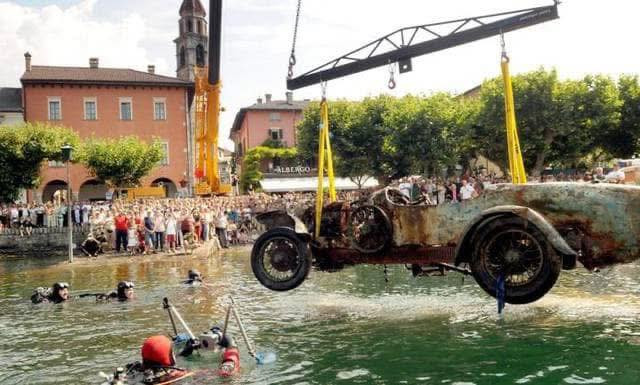
A 1925 Bugatti Type 22 Brescia Roadster emerged from Lake Maggiore in 2009, dragged from depths where it had rested for over 70 years in circumstances that remain disputed to this day. The recovery, witnessed by historians, collectors, and local authorities, revealed a vehicle remarkably preserved by freshwater submersion, its delicate mechanical components encrusted with silt and aquatic growth but structurally intact beneath decades of lake bed accumulation.
The Brescia represented one of Bugatti's earliest production sports cars, built during the 1920s when Ettore Bugatti's small Alsatian factory produced vehicles that dominated motorsport and captured the imagination of wealthy enthusiasts worldwide. Approximately 2,000 Type 22 and Type 23 Brescia models were produced between 1921 and 1926, with surviving examples today commanding values from £400,000 to over £1 million depending on specification, history, and condition.
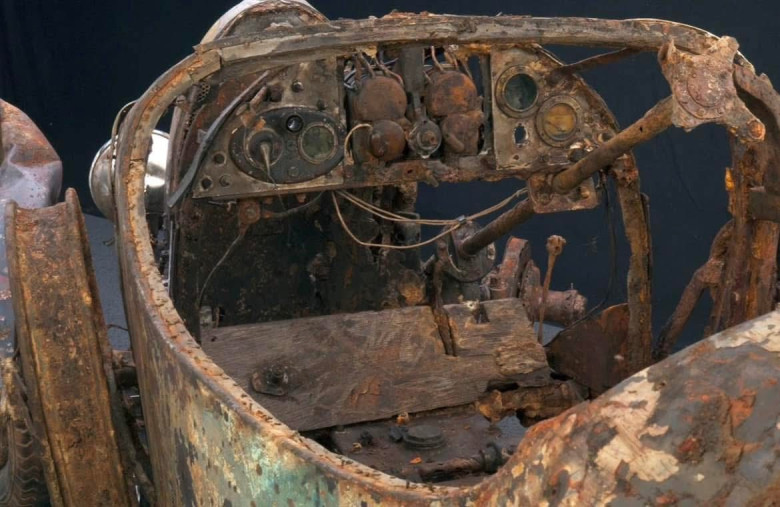
This particular car's condition would charitably be described as requiring complete restoration, though that description fails to capture the magnitude of what 70 years underwater does to aluminum bodywork, steel chassis components, leather upholstery, and mechanical assemblies designed for precision engineering rather than aquatic environments.
How It Got There
The circumstances surrounding how a valuable Bugatti ended up at the bottom of Lake Maggiore depend on which version of events you believe, with theories ranging from smuggling operations gone wrong to insurance fraud to wartime activity that left the car abandoned and eventually submerged.
One account suggests the Bugatti belonged to a wealthy Swiss or Italian owner who attempted to hide the vehicle from authorities during World War II, when luxury cars faced confiscation by occupying forces or governments desperate for metal to support war production. Submerging the car in the lake, according to this theory, represented an attempt to preserve it until hostilities ended and retrieval became safe. The owner either died during the war or circumstances prevented recovery, leaving the Bugatti forgotten until divers discovered it decades later.
Alternative theories propose smuggling operations across the Swiss-Italian border. Lake Maggiore straddles the frontier, with portions in both countries, making it historically attractive for smugglers moving goods to avoid customs duties or wartime restrictions. A Bugatti might have been loaded onto a boat for clandestine transport across the border, only for weather, accident, or authorities to force the vehicle's abandonment in deep water where evidence disappeared and retrieval proved impossible.
The most prosaic explanation involves a simple accident where the car rolled or was driven into the lake, whether through driver error, mechanical failure causing loss of control near the shore, or deliberate abandonment for reasons lost to history. Lakes have claimed countless vehicles over decades through mundane accidents that require no elaborate conspiracy theories to explain.
Whatever the true circumstances, the Bugatti remained undiscovered until recreational divers exploring Lake Maggiore's depths encountered something that shouldn't exist in underwater environments: the unmistakable shape of a vintage automobile.
The Recovery Operation
Recovering a 70-year-old car from significant depth requires specialized equipment and careful planning to prevent damage during the extraction process. The Bugatti rested in approximately 50 meters of water, deep enough to require technical diving expertise but shallow enough that recovery proved feasible with commercial diving equipment and crane apparatus.
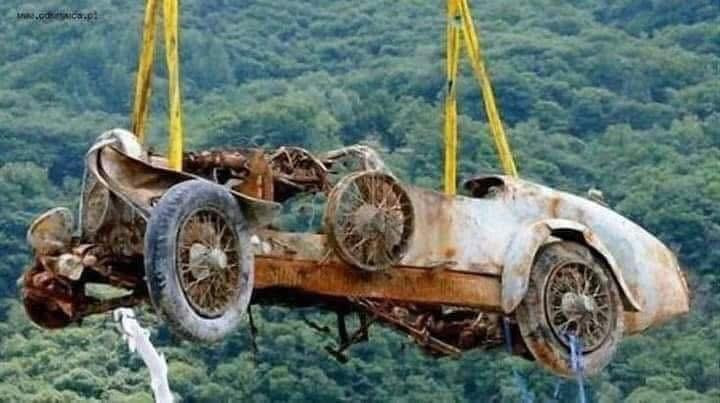
The operation, documented through photographs and video that subsequently circulated widely across automotive media and enthusiast forums, showed the Bugatti emerging from the lake coated in thick layers of silt, aquatic vegetation, and the accumulated detritus of seven decades underwater. Water poured from every orifice as cranes lifted the car onto a recovery barge, the aluminum bodywork remarkably intact despite the extended submersion.
Freshwater preservation proved crucial to the car's survival in recognizable form. Saltwater would have corroded aluminum and steel components beyond recognition within years, dissolving the vehicle into unidentifiable wreckage. Lake Maggiore's fresh water, while still destructive over decades, acted more gently, allowing the basic structure and many components to survive in forms that restoration specialists could potentially work with.
The chassis number, stamped into metal and still legible beneath silt accumulation, allowed researchers to identify the specific vehicle and trace its history through Bugatti factory records. This provenance documentation revealed the car's original specification, delivery details, and early ownership history, though it couldn't explain definitively how the vehicle ended up submerged.
What 70 Years Underwater Does
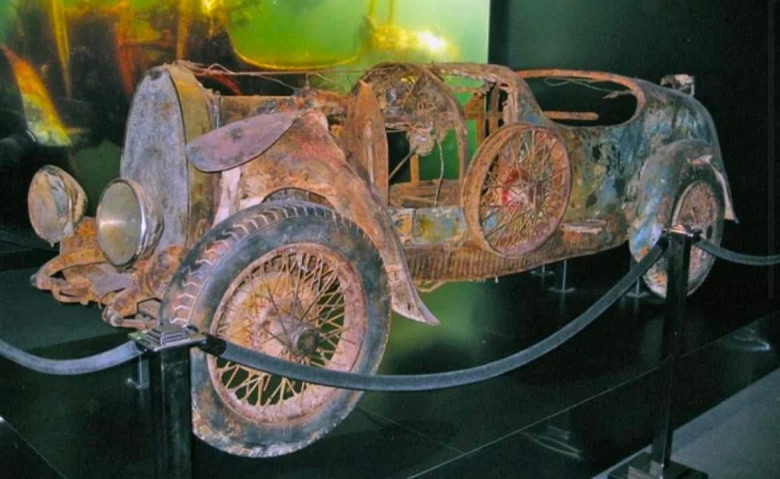
The physical condition of the recovered Bugatti fascinated automotive historians and restoration specialists, who rarely encounter vehicles subjected to such extreme environments for such extended periods. The damage patterns and preservation characteristics provided insights into how different materials and components respond to prolonged submersion.
The aluminum bodywork, while discolored and pitted, retained structural integrity and recognizable shape. Aluminum oxide formation, the white powdery substance that forms on aluminum exposed to water, covered exterior surfaces but hadn't penetrated deeply enough to compromise the basic panel structure. Restoration would require removing these corrosion products, assessing underlying metal condition, and likely fabricating replacement panels where damage exceeded repair capabilities.
The chassis, constructed from steel, suffered more severely. Rust formation compromised structural members, particularly at joints and stress points where water intrusion and corrosion combined to weaken material that once supported the vehicle's weight and driving forces. Whether enough original chassis remained to justify restoration rather than replica construction would require detailed structural analysis.
Mechanical components including the engine, gearbox, and final drive showed extensive corrosion both externally and internally. Water had penetrated these sealed assemblies, corroding precision machined surfaces that once operated with tolerances measured in thousandths of an inch. Pistons fused to cylinder walls. Bearings corroded into solid masses. Gear teeth pitted and corroded beyond salvageable condition.
The leather upholstery, wooden floorboards, and fabric components that once provided creature comfort had largely disintegrated, leaving only fragments and residue that indicated their former presence without retaining any structural integrity.
Remarkably, certain components survived in surprisingly good condition. Glass lenses from headlights and instrumentation remained intact, protected by their non-reactive properties. Brass fittings and bronze bushings showed surface corrosion but retained dimensional accuracy beneath deposits. Even some wiring harnesses, protected by fabric insulation, preserved enough original material to allow analysis of the car's original electrical system.
The Restoration Question
Discovering a rare Bugatti creates immediate questions about restoration feasibility and philosophy. Should such a vehicle be restored to running condition, preserving as much original material as possible while replacing components too damaged to function? Should it remain in as-found condition, preserving the evidence of its extraordinary history even at the cost of never running again? Or should it be partially restored, maintaining its patina and history while stabilizing components to prevent further deterioration?
The automotive restoration community divides sharply on these questions, with strong opinions about the correct approach to historically significant vehicles in unusual conditions. Purists argue that the Lake Maggiore Bugatti's historical significance lies precisely in its condition as recovered, with restoration eliminating the evidence of its unique history and transforming it into merely another restored Type 22, indistinguishable from the hundreds of other examples that survived through more conventional means.
Pragmatists counter that Bugattis were built to be driven, that Ettore Bugatti intended these cars as functional racing and sporting machines rather than static museum pieces, and that restoration honoring his vision serves the car's purpose better than preserving it in corroded non-functional state.
Financial considerations complicate the philosophical debate. A fully restored Type 22 Brescia might command £600,000 to £800,000 depending on specification and restoration quality. The Lake Maggiore car, if restored to concours condition, could potentially exceed £1 million given its extraordinary provenance and story. However, restoration costs for a vehicle in this condition would likely approach or exceed £500,000, requiring complete mechanical rebuilding, extensive bodywork fabrication, and countless hours of specialist labor.
Preserving the car as found, by contrast, requires minimal investment beyond stabilization to prevent continued deterioration. The vehicle retains its unique character and historical evidence while avoiding the enormous costs and philosophical compromises that restoration entails. However, it remains forever frozen in recovered condition, unable to demonstrate the performance and engineering excellence that made Bugattis legendary.
What Happened To The Car
The recovered Bugatti's current whereabouts and ownership remain somewhat unclear, with various reports suggesting it passed through multiple collections and may currently reside in a private European collection. Unlike many significant automotive discoveries, the Lake Maggiore Bugatti hasn't appeared at major auctions or been displayed at prominent automotive events, suggesting the owner prefers privacy over publicity.
Photographs from years following the recovery show the car in similar condition to its initial emergence, suggesting restoration hasn't been attempted or at least hasn't progressed to visible completion. This indicates the owner either embraced the preservation-in-place philosophy or encountered financial or practical obstacles preventing restoration from proceeding.
The lack of public information creates frustration among enthusiasts who would like to know the car's fate but also reflects reasonable desire for privacy from owners who don't wish to subject their possessions to constant public scrutiny and debate about appropriate conservation approaches.
Other Submerged Automotive Discoveries
The Lake Maggiore Bugatti represents the most famous but hardly the only significant automotive discovery recovered from underwater environments. Lakes, rivers, and coastal waters worldwide have yielded vehicles ranging from mundane to extraordinary, each with stories about how they ended up submerged and what happened after recovery.
A 1932 Lancia Dilambda emerged from an Italian lake in similar circumstances to the Bugatti, also apparently hidden during wartime and never recovered. Various Alfa Romeo racing cars have been found in European waterways, their presence attributed to wartime chaos or smuggling operations.
The pattern suggests that using bodies of water as hiding places for valuable vehicles during World War II occurred more frequently than most people realize, though the success rate of subsequent recovery proved dismal as owners died, memories faded, and exact locations became impossible to pinpoint decades later.
Modern sonar and diving technology has made locating these submerged artifacts easier, but legal questions about ownership, salvage rights, and historical preservation complicate recovery even when vehicles are found. The Bugatti's case benefited from relatively clear legal situation, but other discoveries have generated disputes lasting years between finders, original owners' descendants, insurance companies with theoretical claims, and governments asserting cultural heritage interests.
The Broader Significance
Beyond the specific vehicle and its particular circumstances, the Lake Maggiore Bugatti represents something larger about our relationship with automotive history and the extraordinary lengths people will go to preserve or recover objects they deem culturally significant.
A 1920s sports car, however rare and historically important, remains fundamentally just a machine built to transport people more quickly and enjoyably than walking or using public conveyance. Yet the recovery operation required substantial planning, expense, and effort to extract this particular machine from its resting place and preserve it for study and potential restoration.
This level of commitment reflects values that transcend simple transportation function. The Bugatti represents engineering achievement, design excellence, and historical connection to an era when automobiles were transforming from expensive novelties into transformative technology reshaping human civilization. Preserving these artifacts preserves tangible links to that transformation and the people who created vehicles that still inspire enthusiasm nearly a century after their construction.
The questions about appropriate conservation approaches, restoration philosophy, and ultimate disposition apply to countless historically significant vehicles facing similar decisions about how best to preserve them for future generations. The Lake Maggiore Bugatti's unique circumstances created particularly stark choices between preservation and restoration, but the underlying tensions exist for any old car worth more as functioning vehicle than as static artifact.
Somewhere, presumably in a European collection, the Lake Maggiore Bugatti sits as it has since recovery, covered in the patina of seven decades underwater, mechanically frozen but structurally intact, a monument to both human folly that resulted in its submersion and human determination that enabled its recovery. Whether it will ever run again, whether restoration will transform it into another beautiful Brescia or whether it remains forever as found, preserving the evidence of its extraordinary journey, only the owner knows.
But the story persists, reminding us that automotive history contains mysteries still being discovered, that lakes and rivers may harbor treasures waiting for the right diver to stumble upon them, and that a 1925 Bugatti can survive 70 years underwater and emerge to tell tales that speculation alone will never definitively resolve. That's magic worth appreciating regardless of restoration outcomes or ownership details. Some stories simply deserve telling, and the Bugatti that spent seven decades at the bottom of Lake Maggiore ranks among automotive history's best.