

Brake fluid is dead. After a century of drivers wrestling with bleeding brake lines and watching that amber liquid turn black, Brembo has finally cracked the code on killing hydraulics entirely. Their Sensify brake-by-wire system hit production this year, and it doesn't need a single drop of the stuff that's been fundamental to stopping cars since Henry Ford was cranking out Model Ts.
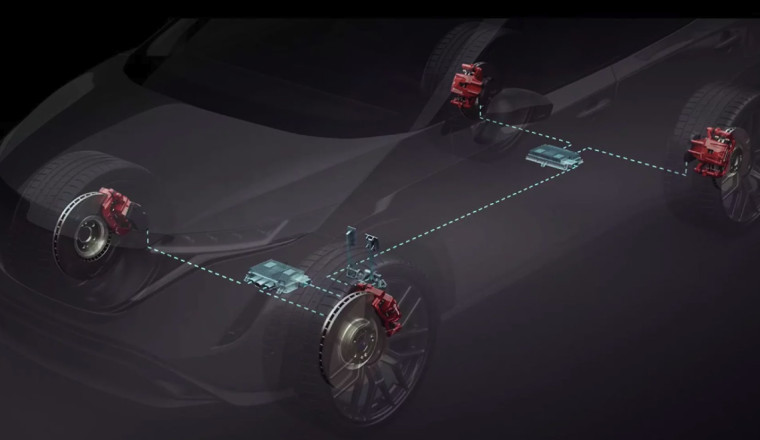
The numbers tell the story of just how revolutionary this shift really is. Traditional hydraulic brakes take 300 to 500 milliseconds to fully engage when you stomp the pedal. Sensify cuts that response time to 80 milliseconds. In braking terms, that's the difference between a gentle suggestion and an instant command. Each wheel gets its own electric actuator controlled by dedicated processors, meaning your right rear brake can respond differently than your left front in real time.
Brembo CEO Daniele Schillaci didn't mince words when the company announced production would begin. "Sensify represents the most significant evolution in braking technology since the introduction of ABS," he told Automotive News Europe in 2023. Given that ABS revolutionized road safety in the 1970s, that's not a small claim. But the technical leap supports his confidence.
The system works by replacing every hydraulic component with electronic alternatives. Instead of brake fluid pushing pistons through metal lines, electric motors directly actuate the brake calipers. Software monitors pedal pressure, wheel speed, and vehicle dynamics thousands of times per second, then tells each wheel exactly how much braking force to apply. The result is stopping power that adapts faster than any human driver could manage.
Lucid Motors signed on as one of the first customers, with their Air Dream Edition serving as a testing ground for the technology. Mercedes reportedly considered Sensify for their EQS lineup, though official confirmation remains elusive. These aren't mass market cars, which makes sense for a technology that likely costs significantly more than traditional hydraulics, at least initially.
Like this? Get the app: iOS | Android
The maintenance implications alone could reshape the automotive service industry. Brake fluid changes, typically required every two to three years, simply disappear. No more bleeding brake lines after pad changes. No more watching that fluid gradually turn from clear amber to dirty brown as moisture creeps into the system. The electronic components monitor themselves continuously, providing predictive maintenance data that tells you exactly when service is needed rather than relying on time intervals or guesswork.
Traditional brake systems fail in predictable ways. Fluid leaks, air gets into lines, moisture causes corrosion. Sensify introduces different failure modes that the industry is still learning to understand. What happens when an electric actuator fails versus a hydraulic line bursting? Redundancy becomes crucial in ways that hydraulic systems never required. Brembo built multiple backup systems into Sensify, but electronic failures can be more catastrophic and less predictable than fluid leaks.
The timing aligns with the electric vehicle transition, but Sensify works on any powertrain. Internal combustion engines can benefit from the faster response times and precise control just as much as electric motors. However, EVs provide the electrical architecture that makes the system more straightforward to integrate. Traditional cars need additional power management and control modules that EVs already possess.
Production ramped through 2023 and into 2024, with Brembo targeting broader market adoption by 2025. The technology faces the classic chicken-and-egg problem of automotive innovation. Manufacturers want proven reliability before committing to volume production. Suppliers need volume commitments to drive costs down. Early adopters pay premium prices for unproven technology, but someone has to go first.
The brake fluid industry just lost its biggest customer segment. After powering through a century of automotive evolution, hydraulic braking faces obsolescence from a technology that was impossible when those first brake lines were laid. Sensify might be the beginning of the end for one of the few automotive fluids that survived the transition from mechanical to electronic control. Just don't expect your neighborhood mechanic to stock the replacement parts anytime soon.
Sources: Automotive News Europe, Brembo Official Press Release