
In the 1990s, BMW’s design department was at a crossroads. It was on the verge of transitioning from the boxy shapes that had served the company so well during its initial conquest of America into a more experimental period, one that introduced not just a fresh styling direction but also gave birth to entirely new vehicle types.
BMW Technik GmbH played the role of midwife. This subsidiary was freed from the constraints of BMW’s commercial side and given a mandate to play fast and loose with the future of what vehicles might look like. Part research and development division, partly think tank, BMW Technik was where Munich execs sent their mad scientists to be kept under strict observation, on the off chance they produced something revolutionary.
The models that made it from Technik’s brain trust into showrooms included the 1989–91 Z1 roadster, with its drop-down doors, and the 2008 ActiveHybrid 7, with its mild-hybrid, twin-turbo V-8 powertrain. Just as fascinating, however, were Technik’s concept cars.
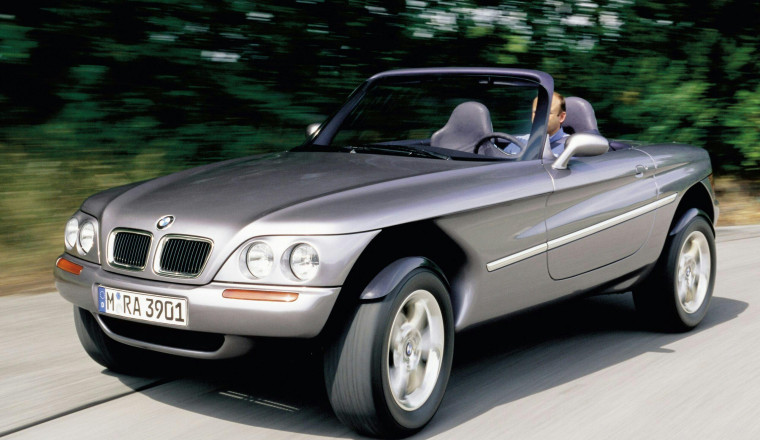
The BMW Z18 Concept is one such tantalizing glimpse of a path not taken. Built in the early 1990s and kept secret until 1995, the Z18 was both of and ahead of its time. As a two-door crossover—BMW’s first—spiritually, it was a German version of the Suzuki Sidekick, a cute ute that echoed the fun factor provided by Japanese SUVs of a similar size. Unfortunately, the Z18 arrived at least 20 years too early for America’s off-road craze.
Like the Sidekick, which continued Suzuki’s in-house tradition of affordable, go-anywhere trucklets, the Z18 Concept drew upon BMW’s own extensive experience of building “enduro” motorcycles — essentially, street-legal dirt bikes. While BMW lacked a history of four-wheelin’, its enduro bikes successfully melded parts from the on- and off-road bins. Technik’s jumping-off point was simple: Why not distill that same sense of adventure into an open-air, four-wheel-drive roadster?
Keep in mind that, in the late 1980s, when the Z18 Concept was developed, BMW hadn’t sold a two-seater for decades. The Z1 would change that, but that Miata-sized model wasn’t intended for North America. The Z18 was an opportunity for Technik to kill two birds with one stone: to produce a larger styling exercise for a potential U.S.-market, two-seat convertible while wowing the world with an out-there off-roader.
Even a cursory look at the shape of the BMW Z18 Concept shows just how successful it was at projecting the styling cues of the upcoming decade. It’s easy to draw a direct line from the Z18 to the production Z3, which went on sale the same year as the Concept debuted (it was delayed for five years to coincide with Technik’s 15th birthday). The Z18 and the Z3 share the same small, square-ish kidney grilles and cabin-to-hood ratio, with a long, sloping bonnet featuring two muscular ridges. The short rear deck and somewhat scalloped bumper are there, too, although closer inspection of the back reveals more E36 coupe than Z3. Other details, like the motorcycle-inspired pairing of big fender cutouts with low-riding “mud guards” over each tire, were unique to the concept.
Of course, the Z18 Concept wasn’t intended to be production-ready, so the maniacs at BMW Technik could get a little crazy with its construction. Rather than adopting the same kind of unibody construction seen on other modern vehicles, they built the body of the Z18 out of fiberglass, over a steel frame that allowed for a flat floor. It’s possible that the plastic shell made it easier to swap various bodies onto the same chassis — imagine the Z18 as an open-bed pickup, or a four-seater, which were both sketched out by Technik in the vehicle’s design brief..
Most of the Z18 Concept’s outré equipment was self-evident, like its tall ride height and the waterproof instrumentation and even the cheeky paw prints cut into its tire treads. Less obvious—at least, until you turned the key—was the roadster’s 4.4-liter V-8 engine. This mill produced 350 horsepower and was dubbed the M62 when it made it under the hood of the automaker’s official first SUV, the X5, a few years later. Four-wheel drive was also installed on the Z18.
As unusual as it might have seemed at the time, in hindsight there was a strong business case to be made for the BMW Z18 Concept as a limited production model. First of all, the Z3 was a success. More importantly, the sudden proliferation of cute utes in the late ’90s—the two-door Toyota RAV4, the Suzuki X-90, the Sidekick/Tracker, Isuzu Amigo and VehiCross, and even the Land Rover Freelander—revealed that consumers were definitely interested in small, unusual-looking off-roaders.
True, none of those pint-sized haulers of the ’90s ever carved out more than a casual foothold on the upward slope of SUV sales. Still, the BMW would have been the only luxury model in play, as every other high-end automaker (BMW included) focused on larger, sport-utilities with four doors.
It’s hard to say how much the presence of the Z18 in the line-up would have changed things for BMW. Although the two-door SUV craze had mostly petered out by the mid-2000s, it’s possible that this design-forward outlier could have given BMW a better lead-in to the similarly unusual X6 that launched for the 2008 model year and started the “coupe SUV” trend. Had the Z18 succeeded, perhaps Mercedes-Benz and Porsche would have repurposed their own roadsters, giving us a legacy of SLK-4Matic and Boxster off-roaders that our own timeline was denied.
Unfortunately, it’s clear by the five-year gap between the Z18’s conception and its public bow on the world stage that BMW had little to no intention of following in the footsteps of Audi or Dodge, whose TT and Viper concepts did actually make it into showrooms. The world would have to wait until the early 2000s for BMW’s brand bosses to fully embrace the weirdness of Bangle-era styling and start taking the kind of design risks that have become a hallmark of its autos today.