

There is a version of this story where it works out. Audi creates a China-only sub-brand, drops the iconic four-ring logo to signal a fresh start, partners with SAIC, builds a technically impressive electric car on a cutting-edge 800-volt platform, prices it aggressively, and rides a wave of Chinese EV demand to a profitable new market position.
That is not the story that has happened so far.
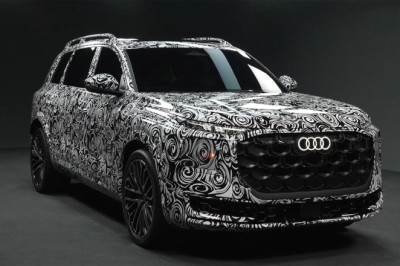
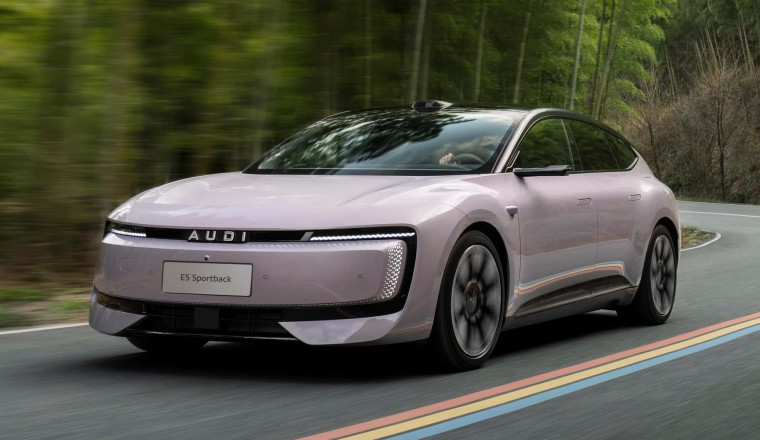
The AUDI brand, spelled in capitals to distinguish it from the parent company, launched its first model in August 2025. The E5 Sportback is a long-wheelbase electric fastback built on the Advanced Digitised Platform, developed jointly with SAIC. On paper, the specification is genuinely competitive: a 2,950mm wheelbase stretching it into near-executive territory, a top-of-range Quattro variant producing 776 horsepower, a 100kWh battery delivering 773km of CLTC range, LiDAR fitted as standard across the entire range, and a 59-inch pillar-to-pillar screen dominating the interior. The starting price of ¥235,900 (approximately $32,500) placed it in the same territory as the Tesla Model 3 in China. When pre-sales opened in August, Audi claimed it had taken 10,153 orders in 30 minutes.
By January 2026, total deliveries since launch had reached 7,070 units. In January alone, 420 cars were sold.
To put that in context: the Xiaomi SU7, which launched in March 2024 into a blaze of tech-brand hype, sold over 250,000 units in its first year. The Zeekr 007 GT, one of the E5's direct competitors, has consistently outsold it in monthly figures. The Nio ET5 Touring has done the same. The car the AUDI sub-brand named China Car of the Year is shifting fewer units per month than a quiet week at a single busy Shanghai dealership.
The Discount Has Arrived
Audi has now announced a combined ¥30,000 discount on the E5 Sportback, structured as ¥10,000 in purchase tax compensation, ¥10,000 in cash off the price, and ¥10,000 in trade-in subsidy. That brings the entry price to ¥205,900, just under $30,000 at current exchange rates. Buyers can also choose between a five-year zero-interest financing plan or a seven-year low-interest option. The discount is described as limited-time, running until 31 March. Whether it is extended will depend on whether it moves cars. Given the sales trajectory so far, a quiet extension looks more likely than an expiry.
The price reduction pushes the E5 into direct competition with the Zeekr 007 GT and below the Xiaomi SU7. Whether that helps is not guaranteed. Chinese buyers have already decided, in large numbers, that they prefer those cars. A price cut is an argument for reconsidering. It is not the same thing as a reason to choose differently.
What Went Wrong
The E5's commercial failure is not primarily a product problem. Electrive's analysis raised a point worth taking seriously: in Chinese market practice, pre-order figures like the 10,000 in 30 minutes claim are based on non-binding reservations, and Chinese media sources suggest that only around 5 percent of such reservations typically convert to binding purchase contracts. Even accepting that conversion rate, the delivery total suggests that regular ongoing sales have failed to develop after the initial pre-order wave cleared.
The deeper problem is the competitive environment. Audi created a sub-brand and dropped its own logo specifically to signal that AUDI was a local product, not a Western import wearing a different badge. The gamble was that Chinese buyers want a modern, locally developed electric car and that the Audi engineering heritage would carry value even without the rings. What the sales data is suggesting is that in the price range the E5 occupies, buyers have strong preferences for established Chinese brands with deeper software ecosystems, better-known apps integration, and native digital infrastructure. The E5 has WeChat, Alipay and local navigation built in. It also has a nameplate that was created eighteen months ago.
MotorBuzz covered the broader Chinese platform strategy earlier this year, documenting how Western manufacturers from Land Rover to Ford have been building on Chinese-developed architectures as the cost and time advantages become too large to ignore. AUDI is that strategy in its most direct form: a brand built from scratch on Chinese technology, for Chinese buyers, sold without any of the Western heritage that gives the parent company its pricing power in Europe and North America. The result, so far, is a car that competes on Chinese terms in a market that already has very good Chinese cars.
Like this? Get more MotorBuzz delivered to your phone. Download the app: iOS | Android
What Comes Next
AUDI's second model, an SUV called the E7X, was shown in November 2025. It measures 5.05 metres long and will be offered in rear-wheel-drive and all-wheel-drive configurations. A large sedan is planned to follow on the same platform. The product pipeline is intact. The question is whether a brand with 7,070 total deliveries can establish enough presence to give those future models a fighting chance when they arrive.
It is worth noting that plenty of car brands have survived slow starts. The early reception to a new brand rarely predicts its ceiling, especially in a market as dynamic as China's, where consumer preferences shift quickly enough that a product that feels dated today can feel fresh again with a software update. Audi has deep pockets, a genuine engineering partner in SAIC, and a platform capable of producing compelling products. None of that is trivial.
But the Chinese EV market does not offer patience as a courtesy. The Zeekr 007 GT and Xiaomi SU7 are not going to slow down while AUDI finds its footing. And a brand defined by its rejection of the four rings now needs to explain what it stands for instead, to buyers who already have very good reasons to choose something else.
The pre-order enthusiasm was real enough. Turning it into a car business is proving considerably harder.
Sources: Carscoops, Motor1, CarNewsChina, Electrive, CarBuzz. All sales figures from China EV DataTracker via CarNewsChina. All analysis and editorial commentary is original.