

We know that the Ruf RTurbo is fast because in the February 2002 edition of Road & Track, the magazine’s steely-nerved road testers put the new Ruf through its paces, and the results had their test equipment blowing a fuse.
It punched its way from standstill to 60mph in 3.8 seconds and powered past 100mph in just 8.1 seconds, dispatching the quarter mile mark in 11.9 seconds and holding 0.97g around a skidpad. But in the world of Ruf, that’s just foreplay. The German machine is built for das autobahn, and didn’t really show its true colors until it got up and running, flat-shifting from fourth to fifth… to sixth. At the Nardò Ring proving ground in Italy, the RTurbo didn’t let up until its speedo needle swung all the way to 217mph.
Actually, if we’re going to split hairs—and why wouldn’t you, given that extra half a mile per hour might be what sees you edge ahead of a bona fide supercar like the Jaguar XJ220—the RTurbo was officially recorded as 217.5mph. And, believe it or not, that was the least-powerful version.
Yet even with that impressive bit of pub trivia rattling around inside my head, nothing could prepare me for the moment I floored the throttle of Adam Treanor’s RTurbo and let it run for as long as I dared—dare being the mindset needed to open up a car like this, given how the U.K. struggles to accommodate a car with performance of such magnitude.
But Adam Treanor and his parents, who owned this RTurbo from new in 2003, have most definitely let it off the leash. It has lived a full—and full-throttle—life, clocking up almost 100,000 miles, and in the process notching up more than 100 laps of the Nordschliefe and lapping around 20 of Europe’s greatest motor racing circuits, not to mention countless autobahn sorties.
According to Treanor, who took on the RTurbo after his parents’ retirement in 2020, the folks at Ruf believe it is the highest-mileage water-cooled Ruf they know of. And in Ruf’s books, that earns its owners tremendous respect. All too often these days, the company’s cars are bought as assets that sit in a collection and rarely get driven in the way their makers intended.
Treanor’s mother would drive him to school in the RTurbo. Now, Treanor and his wife do the same for their three young children. But when they get the itch, they’ll take it back to Germany’s autobahns, “where you really appreciate just how fast it is,” says Treanor, and drop in to see their friends at Ruf (Treanor once spent a year working with the company), or join a track day at the Nürburgring.
To recap, the RTurbo was based on the 996-generation 911 Turbo, and followed in the tire tracks of some significant cars that grabbed global attention for their engineering, performance and useability. The best-known of those is the CTR, the car that featured in the 1989 video Faszination auf dem Nürburgring and continues to inspire an entirely new generation of wannabe hot-lappers to pedal their 911 around the Nordschleife wearing stonewashed jeans, white socks and slip-on loafers.
Introduced in 2001, the RTurbo was initially available as a new, factory-built Ruf with its own Vehicle Identification Number (VIN) starting W09, in coupe or cabriolet bodies (supplied to Ruf as a body-in-white structure) and with a choice of rear-wheel drive or four-wheel drive. It was also possible to have Ruf convert an existing 911 Turbo, but that wouldn’t have the Ruf VIN. Either way, the work was carried out at Ruf’s Pfaffenhausen workshop to the west of Munich, and a finished, factory-order coupe would have cost $191,800, compared to $12,400 for a 911 Turbo and $154,000 for a GT2.
And what work it was. The 3.6-liter, horizontally opposed six-cylinder Mezger engine from the 911 Turbo was given a working over that included tweaking the existing KKK K16 turbochargers, a remapped engine management system, upgraded intake manifold, new valves, a modified VarioCam variable valve timing system and an uprated exhaust system. The engine mounts were GT3 items, and the drivetrain used a GT2 transaxle and limited-slip differential with a reinforced clutch, while the adjustable suspension and Brembo brakes helped keep all that power in check, as did the choice of the basing the car around the 911 Turbo body, which had greater rigidity than a Carrera.
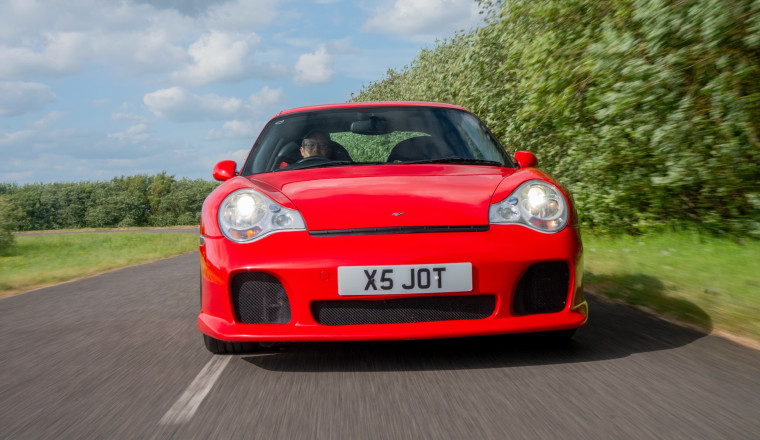
Initially, the RTurbo boasted 520 hp, but by 2002, Ruf was tempting buyers with optional packages that raised that to 550 hp or 590 hp. (The three are known as the 520, 550 and 590, reflecting their power outputs.) Our car, now registered X5 JOT, left Pfaffenhausen with the middle of these three options, meaning it came with larger KKK K24 turbochargers in place of the 520’s K16 units.
Treanor’s father was one of Ruf’s customers who’d come knocking at the door, asking for more—but not because he was being greedy. “My father blew up the engine in 2007,” recalls Treanor. It happened at, predictably, the Nürburgring, and blowing the engine not only necessitated a rebuild but justified a step up to the 590 package.
Years later, running hard on a stretch of autobahn in fifth gear, at about 160mph, Treanor experienced that same sinking feeling as his father doubtless did. “It was near the Nürburgring one Sunday morning, and I had got up early for a blast, and on a long uphill drag it just let go.”
So back to Ruf it went. Treanor sat down with Christian Treiber, Ruf’s master engine builder, and pondered his options for a rebuild. “Because I was very good friends with him, we had a sort of deal that if I blew the engine up it would go back to him, because he built both engines originally!” The engine had suffered a failed connecting rod, which did no good whatsoever for the cylinders, pistons and crankshaft.
For the next rebuild, Treanor used his powers of persuasion to convince Treiber to turn up the wick on the RTurbo further still. It jumped to 800 hp and 738 Ib-ft, which, from a power-to-weight perspective, edges ahead of a Bugatti Veyron.
It’s at this point that I raise my eyebrows and ponder the significance of those two numbers in a car weighing around 3000 pounds, driving only the rear wheels, and thank the weather gods that they have blessed me with dry roads.
Apparently, Treiber only entertained Treanor’s request because he knew the family so well, knew how they used their car, and trusted their judgment. For anybody else, the answer would have likely been a polite but firm ‘nein’. Reaching these numbers called for an engine that grew from 3.6 to 4.0 liters and a new crank—in this case a GT3 RSR 4-liter crank—together with a new set of 102mm Mahle Motorsport forged pistons and cylinders, lighter and stronger CP-Carrillo connecting rods, and larger, lighter turbines for the KKK turbochargers, along with a larger free-flowing exhaust.
With so much torque, the six-speed manual gearbox needed attention, too. So third, fourth, and fifth now feature forged gears with fewer, larger teeth that should mean they’re stronger, complemented by steel synchros from the GT2 RS. I ask about the gearing and maximum speed, and the answer, predictably, keeps my eyebrows raised. “Originally with the 550 engine, with the longer Ruf sixth gear, it was geared to do 351kph [218mph] but this car came with the stock gears, and with the 7100rpm [limiter] it would do 330kph [205mph] and I used to do it a lot in Germany and it would just hit it like doing-doing—you could feel it thump into it.
“Now the redline is slightly higher, it will maybe do 340 kph [211 mph], but if we got the longer sixth gear, it would run to 375 kph [233 mph] no problem. I wouldn’t recommend it, though. It’s freaking scary and seriously loud because of the wind noise!”
Treanor has video of the speedo from before and after the 800-hp conversion, and estimates that the reduction in time accelerating from 300 to 320 kph was 16 seconds. “We’ll do autobahn runs about twice a year now,” he tells me, “but when my family lived in Munich [his father worked for Siemens], the car would be charging on the autobahn every day.”
And then there were the Sunday morning rituals… Father and son would rise at 4 am and take the RTurbo and a CTR ‘Yellowbird’ for a 200km round trip and max the cars together. “We’d always get stopped at the same police checkpoints and got to know the local police; they would be looking to catch drunk drivers and partygoers coming back from a rave!”
Where did the Ruf journey begin for the family, I wonder? Treanor Senior has his son to blame for his Ruf habit: “We went to AFN Porsche in Guilford, to see about changing from an E39 M5 to a 996 Turbo, and Dad ended the test drive and was like, ‘It’s not much faster than the M5’ at which point I said, ‘Well, there’s this guy in Germany called Alois Ruf…’ and I guess I ended up costing my father a fortune!”
Time to hit the road. The four-liter twin turbo unit starts without hesitation, and I suggest Treanor drives first, so I can take it all in and quickly learn about any quirks and get the most out of it. It turns out, there aren’t any quirks. This RTurbo’s engine proves surprisingly flexible and willing; as Treanor had assured me, anyone can drive it.
The cabin is at once 996 Turbo familiar, yet it’s fun to play a game of spot-the-difference. There’s are Day-Glo green Ruf dials; a leather-stitched three-spoke steering wheel with Alcantara placed around the quarter-to-three hand positions and Ruf logo embossed on the hub; Ruf logos on the speedo and gearknob as well as on the sill plates; a Ruf aluminium and rubber pedal set; a suede-covered cabin roof which neatly hides the fully integrated roll cage; and in the back, the seats have been removed and across the void sits a bracing bar. The bodywork modifications—including Ruf’s signature air intakes atop the rear quarters—are tasteful yet functional, with the bespoke wing mirrors critical to reducing drag at autobahn speeds.
The exhaust booms away at around 2000rpm, but seemingly quietens after that as the engine note muscles in, while the gears whine just enough that you know things have been changed down below. It seems docile and drivable in everyday traffic, rides with a suppleness that escapes modern 911s and doesn’t scream look-at-me! the way a new GT3 RS does.
And then the road opens up, the throttle opens up, and my stomach feels like it is being opened up. There are one or two supercars in which I have experienced a similar sensation before—the 1500hp Bugatti Chiron, for example—but it feels all the more peculiar and hard to calibrate what’s happening when you’re in what could almost pass for a stock 996 Turbo.
Beyond 3500rpm, the full rush of the turbos gets underway, and that forced induction gives the engine an almost surreal quality as it surges on some sort of fast-forward mode through the flat-six’s rev range.
Now it’s my turn to slide into the ‘elephant ear’ GT3 seats, which manage to both embrace you in place while feeling supple to the touch. The clutch isn’t especially heavy, the throttle response is wonderfully alert, the ride on the 18-inch RUF three-piece wheels and custom Bilstein dampers pleasingly pliant.
The engine pulls cleanly from 1000rpm, even in sixth gear, but by 4000rpm the back tyres and limited-slip differential are earning their keep as all hell breaks loose. The tail squirms under the tidal force of all that torque, and all of a sudden, you have covered the stretch of dual carriageway that was ahead of you, gobbling up ground with arcade-game speed.
Happily, the Brembo brakes are up to the job, even if the pedal does feel a little soft. Happier still is the way the RTurbo loves to turn into a corner. Once you apply a little lock the power assistance has the most delicious weighting with the distinctive 911 traits, and through a sequence of consecutive corners it rolls across the rack with a buttery action and enough information about when you are reaching the front tires’ limit of grip to give the confidence to make this far more than a point-and-squirt machine.
Needless to say, with so much torque and power, you could back out and then get straight back onto the throttle and ride out every corner in a cloud of tire smoke, but not today. The environment isn’t right, and it would be a crime to reduce this storied car to a mangled wreck just for the sake of my bravado. So I revel in the rush of the power delivery, the addictive thump of torque that blends seamlessly into power and makes the RTurbo feel as though it won’t be contained by nuisances like gravity, friction, and air resistance.
If someone told you it was powered by a nuclear reactor, you’d believe them. Again and again I run through third and into fourth gear, marveling at the turn of pace but wondering at what lies beyond, should you ever find yourself on the autobahn at 4 am… Yet to remain so drivable and user-friendly at the same time is quite the feat.
Ruf has long been the real deal, a fact endorsed by Porsche itself when, in 1983, it agreed to supply Ruf with bare chassis for the BTR and its own VIN plate. And for many buyers in this rarefied space, it’s this legitimacy—the fact it was reinterpreting the boundaries of Porsche long before the many, many other Porsche modifiers existed—that makes it a must-have marque.
But putting that to one side, like buying a van Gogh and locking it away in a vault, or placing the winning bid for John Lennon’s guitar but never playing it, not using the RTurbo in the way its creator intended would be tragic. In that respect, the two generations of Treanor family have done justice to Ruf’s vision. Adam continues to drive the car as often as possible and as hard as possible, and doesn’t worry about the Venn diagram of rarity, mileage, condition, and value and contemplate mothballing like some kind of trophy to be kept polished in a cabinet. And with a third generation of Treanors now in the passenger seat, that looks set to continue for decades to come.
The RTurbo was born to fly free, and surely none has flown quite as far and high as this one.