


By RAY MASSEY, MOTORING EDITOR
The rain in Spain, goes the old hit musical song, stays mainly in the plain.
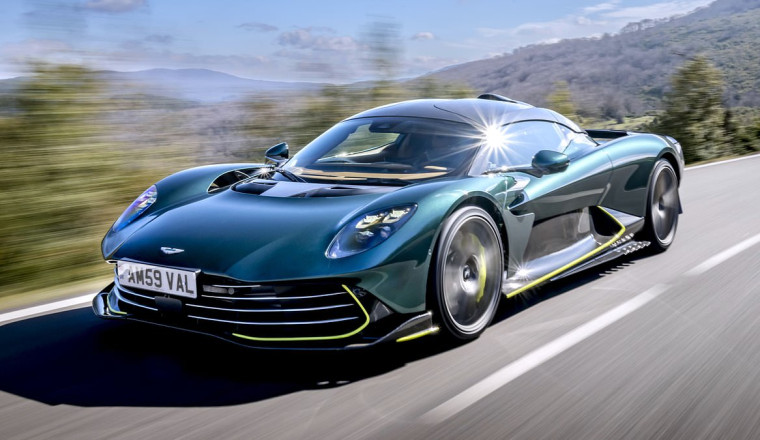
And sod's law says so it was for my first drive of Aston Martin’s stunning new Valhalla road-legal and track-ready 217mph hypercar.
If there was ever car you rather didn't coincide with a deluge, rather than the expected early spring sunshine in Northern Spain, this is it.
As raindrops cascaded from cloudy black skies, I prepared to test-drive on slippery public roads and a soggy race-track - a £1million pound two-seater with two swing-up doors and more than 1,000 horsepower of propulsion, equivalent to ten Ford Fiestas. Sweaty palms barely covers it.
As Aston’s first plug-in hybrid and first series production mid-engined supercar, the Valhalla has been at least seven years in the making - with many revisions along the way.
It's already won some fans TV chef Gordon Ramsay is an early customer and has already taken delivery and been pictured with his.
An earlier version of the car also enjoyed a brief cameo appearance as a potential future 007 car in the last James Bond movie ‘No Time to Die’ in 2021 marking actor Daniel Craig’s swansong as the British spy.
Now it was my mission to drive it - first on the track and then on the road.

Aston Martin’s new Valhalla road-legal and track-ready 217mph hypercar is here - is it worth the cool £1m price tag?
Let’s be honest, short of a Lottery win, few if any of us will be lucky or wealthy enough to ever own a Valhalla - and all 999 super-coupes are pretty much sold out now anyway to global Aston Martin fans with funds.
However, as with high end catwalk fashion, great works of art, exclusive properties, or luxurious holidays, we can but admire and dream.
Climbing in - the first challenge
You sit noticeably lower than in most competitors’ cars, and your field of vison also lower which requires mastering some important techniques.
Just as posh finishing schools used to teach polite young ladies the correct way to enter and leave a sports car without losing their dignity, so climbing into Valhalla’s driver’s seat (especially with a helmet) requires some dexterity and decorum.
You must lean in and forward to grab the far side of the sports seat and then slide in while carefully shifting your weight across the seat.
To get out again, you roll and pull yourself up with the great wing-like doors above you. It’s a great work-out for the abs.
In Norse mythology Valhalla is the heavenly afterlife or paradise reserved for the bravest Vikings who die in battle - and the gods must have been smiling a little as the rain started finally to abate at the Navarra race circuit set a among rural rolling hills and open terrain.
So snugly installed in the racing-style cockpit (snake-hipped Italian waiters will have more wriggle room than those of us broader in the beam in the high-backed encompassing sports seats) it’s time to fire up the start button and proceed.

The racing cockpit is a snug fit for many and requires dexterity to get in and out
A far cry from a Prius plug-in hybrid
To put things in context: the dramatically-styled and low-riding Valhalla is a car that is almost the same length and weight as a well-speced £40,0000 family Toyota Prius plug-in hybrid, but accelerates from 0 to 62mph in a quarter of the time (at 2.5 seconds) and costs more than 20 times more, starting from £850,000 before tempting bespoke extras push customers’ batting-average prices to beyond £1million each.
Some 50 per cent of cars have high levels of personalisation from Aston’s bespoke Q Branch.
Riding on 20-inch wheels at the front and 21-inch forged alloys at the rear, Valhalla is powered by a mighty 828 horse-power (hp) 4.0 litre twin turbo V8 petrol linked to a high power battery and three electric e-motors which add a further 251hp - taking the total to 1,079hp and making possible the g-force inducing 0-62mph acceleration in 2.5 seconds.
It has a zero-emissions electric-only range of around 9 miles at speeds of up to 80mph.
The additional electric drive comprises two twin EV motors at the front and one at rear integrated into the new 8 speed dual clutch transmission with paddle-shift as well as auto.
The set-up means the electronic brain can independently direct varying degrees of power seamlessly to different wheels or wherever it is needed most when the car is negotiating bends, accelerating hard, or tackling challenging terrain.

It starts from £850,000 before tempting bespoke extras push customers’ batting-average prices to beyond £1million each

The Valhalla is powered by a 828hp 4.0 litre twin turbo V8 petrol linked to a high power battery and three electric e-motors which add a further 251hp
Read More
Porsche Cayenne Electric review: New 1,140bhp SUV is the tipping point for too much power in a family car

Keep your licence - try a track
Valhalla shares performance DNA with Aston’s £2.5million Valkyrie - a 6.5litre V12 hybrid engine producing more than 1,100 horsepower - and F1 racing tech, says Aston Martin.
But if you value your driving licence, you really need access to a track on which experience Valhalla’s full potential.
I certainly gave it my best on the Navarra race circuit with foot-flat down on the straights before hitting the brakes ahead of tight corners on which - despite the wet - it remained grounded, grippy and confident.

You really need access to a track to experience Valhalla’s full potential. It shares performance DNA with Aston;s £2.5m Valkyrie
But it was only when I swapped with my co-driver, Le Mans winning race driver and Aston Martin test-driver Darren Turner, that I experienced the full awesome power and balance of this car - though even he acknowledged the effect of the damp on the tarmac.
Out on public roads I enjoyed more relaxed though spirited driving through the Spanish countryside.
Valhalla’s manners though towns and villages were surprisingly good, but it’s on the open roads and motorways that more of the beast can be unleashed - but only up to speed limits if you want to escape a ban.
There are four driving modes selectable via a physical rotary dial: full electric EV for near silent-running; Sport- the default starting mode - which engages the hybrid engine for more relaxed grand touring driving; Sport+ for engaging and energising performance which flatters the ability of drivers like me; and Race mode for the track if you are an experienced driver wanting to be more in control.
Within Race, there are nine settings for removing some or all of the electronic stability driver aids. Engineers said the car had been set up through the chassis controls to feel like a rear-wheel drive car.
In EV mode Valhalla takes drive exclusively from the front axle. And there is no ‘reverse gear’.
Rearward drive is provided in all drive modes by the two front axle e-motors.

Valhalla has extreme aerodynamic styling and carbon-fibre single-cell monocoque design to improve the car's aerodynamics
Aerodynamics for speed AND braking
Valhalla’s extreme aerodynamic styling and carbon-fibre single-cell monocoque design is not just aesthetic - it has real purpose.
The car’s active aerodynamics system keeps the car rooted and achieving more than 600kg of downforce in the speed range from 149mph to 217mph by subtly changing the angle of attack of the front and rear wings.
Electronic sensors monitor this along with suspension, braking, steering, and powertrain systems to optimise dynamic ride.
There was close collaboration on fine-tuning with Aston Martin Performance Technologies– the consulting arm of the Aston Martin Aramco Formula 1 Team.
Only in Race mode does the rear ‘T-Wing’ rise up by 255mm for maximum downforce.
In pure EV, Sport and Sport+ modes, the rear wing remains stowed to maintain Valhalla’s elegant silhouette. 'E-boost' gives the driver an instantaneous burst of extra power.
Also in Race mode the car's powerful carbon ceramic friction brakes are supplemented by the car’s active aerodynamics creating an 'airbrake' that acts 'like a parachute' to slow the car down.
Regenerative braking helps create and store electric charge.

It has a racing-style cockpit with two digital screens and a sports steering wheel
Tempting extras
During its long gestation, Valhalla was first shown as a concept at the 2019 Geneva Motor Show , with an early production version shown at Silverstone in 2021 and he final production model unveiled in 2024.
Among the most popular options added to Valhalla’s £850,000 starting price are: the painted exterior graphics pack (from £10,100); magnesium wheels (£18,500); twill carbon interior (£12,200); ultrafine wings badge (£7,600); and painted interior accent colour (from £1,100).
CEO Adrian Hallmark said: ‘On paper and on-track Valhalla delivers the most driver-focused, technologically advanced supercar, with true hypercar performance and yet on the road it is as useable and enjoyable as any Aston Martin.’
He has a point.
The Cars & Motoring verdict...
Valhalla is a car with real drama - even in the rain.
My confidence with it grew as the weather - and my feel for the car -improved.
But it’s still a far cry from an everyday family runaround.
It’s been a tough time for Aston Martin which last month announced it was cutting up to 600 jobs - around 1 in 5 of its 3,000 strong workforce - after US tariffs were blamed for the firm's net losses jumping 52per cent to £493.2million last year.
After the rain, Aston could do with finding a pot of gold at the end of its rainbow.
This could be it.
If only I had a spare million...