PROS ›› Great chassis, fun drivetrain, attractive styling
CONS ›› Cramped second row, no manual option, pricing
Most automotive enthusiasts love a good hot hatchback, but there’s a problem. They often come with a certain reputation. Maybe that’s because most show up to the party with giant wings, aggressive vents, and styling that looks like it was born of an energy drink and Need For Speed Underground binge session.
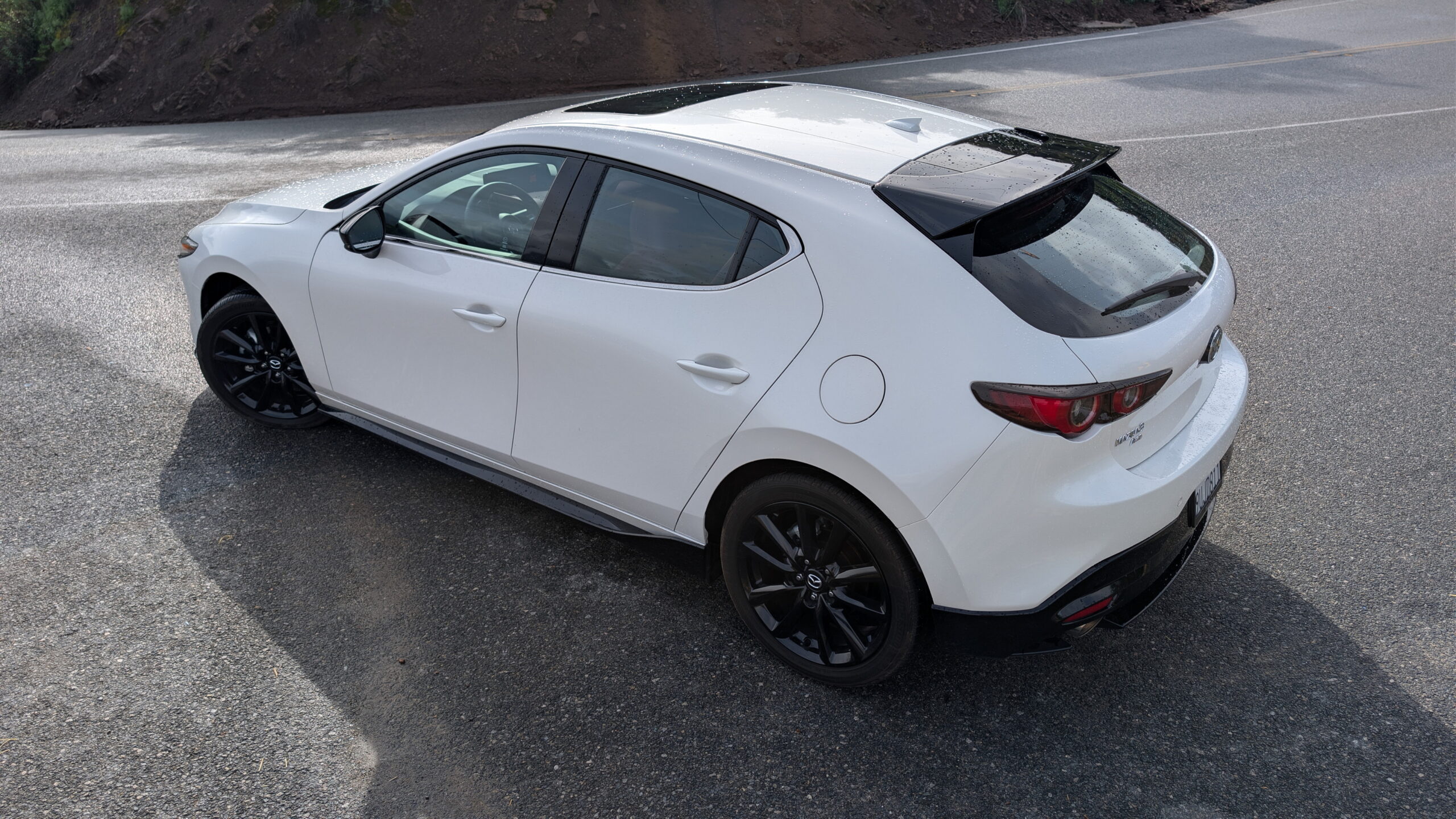
The 2026 Mazda3 Turbo Hatchback takes the opposite approach. Instead of shouting, it whispers. Instead of chasing Nürburgring lap times or light-to-light drag races, it eschews such behavior for an overt civility. Park it in front of a well-heeled estate, and it doesn’t look out of place or gaudy. It might even look the part.
But that calls into question just what the 3 Turbo Hatchback really is. Does it have the chops to be a true hot hatch? Is it masquerading as a luxury vehicle but without the quality to back it up? Why does it appear to be in a segment all by itself? To find out, we procured one for a week-long drive in California.
QUICK FACTS
› Model: 2026 Mazda3 Turbo Hatchback › Starting Price: $39,125 after destination and delivery › Dimensions: 175.6 L x 70.7 W x 56.7 in H (4,460 x 1,795 x 1,440 mm) › Wheelbase: 107.3 in (2,725 mm) › Curb Weight: 3,141 lbs (1,425 kg)* › Engine: 2.5-liter turbocharged four-cylinder › Output: 227 horsepower (169 kW) and 310 lb-ft (420 Nm) › 0-60 mph: ~5.5 seconds (0-96 km/h)* › Transmission: Six-speed auto › Fuel economy: 23 City / 31 Highway / 26 Combined* › On Sale: Now
*Manufacturer
It was there when we tested the new Toyota bZ Woodland and C-HR, when the new Highlander came out, and again later in the week when we drove the all-new Mazda CX-50. Now, it’s the star of the show, and it might just be the closest thing we’ll ever get to a four-door MX-5.
Styling
Mazda’s Kodo design language has aged remarkably well on the Mazda3 hatchback. In fact, it hasn’t been meaningfully refreshed in years. Yet it still looks as modern as anything else in the company’s lineup. That’s partly because Mazda resisted the temptation to overdesign it in the first place. The shape is smooth, sculptural, and confident without trying too hard.
Read: 2026 Mazda3 Gets Pricier But At Least Keeps The Manual
Where many rivals lean into “boy racer” energy, the Mazda3 hatch feels more like matured single-parent energy. It’s stylish and thoughtful rather than loud. The sweeping roofline, the thick rear pillars, and the smooth body sides give it a premium vibe that still stands out in a segment dominated by sharp creases and aggressive fake vents.
Even parked among newer vehicles during press events, the Mazda never looked dated. That’s not easy to pull off in the compact car world. It gives this little car a bit of character and charm that so few others do. That said, it’s not all perfect. The rear end is polarizing. From some angles, it’s attractive, but from most, it feels a little bit heavier than the rest of the car.
Interior
The cabin also kicks things off with a lot to like. The front seats are excellent. They’re supportive, comfortable, and easy to adjust for a wide range of drivers. The cabin design walks a fine line between premium and luxury. The materials and design appear far more mature than the car’s compact-car roots might suggest. For example, the deep red upholstery in our test car looks and feels swanky. Good luck finding something similar in a Honda or Toyota.
For now, at least in the 3, Mazda also continues to buck the touchscreen-first trend with its command knob infotainment controller. It’s a system that might confuse new users for about five minutes, but once you learn it, it becomes second nature. Better yet, you can navigate menus without taking your eyes off the road. That’s something that’s nearly impossible with most touchscreen interfaces.
The rear seat, however, is the biggest drawback. It’s tight. Very tight. Sitting behind my own driving position required a bit of contortion, and even once seated, closing the door felt like an exercise in spatial engineering. Adults can survive back there for short trips, but anything longer than about twenty minutes might become uncomfortable.
Kids, on the other hand, will be perfectly fine. In fact, they’ll probably feel kinda special as it looks like a high-brow space built with them in mind. Cargo space isn’t huge either, but it’s surprisingly usable. The hatch offers 20.1 cubic feet (569 liters) of cargo capacity, and during my week-long road trip, it easily swallowed luggage without needing to fold the rear seats.
Fuel Economy
Fuel economy is another area where the Mazda3 Turbo requires a bit of compromise. The naturally aspirated Mazda3 with its 2.5-liter engine makes 186 hp (139 kW) and achieves an EPA rating of roughly 27 mpg city / 35 mpg highway / 30 mpg combined.
The turbo version sacrifices some efficiency for performance, coming in around 23 mpg city / 31 mpg highway / 26 mpg combined. Across a mix of canyon driving, highway cruising, and city traffic, I averaged 24.9 mpg, which aligns pretty closely with those estimates.
It’s not terrible, but it’s also not the kind of efficiency buyers looking for maximum fuel savings will prioritize.
Drive Impressions
Here’s the best part. It’s a blast from behind the wheel. Under the hood sits Mazda’s 2.5-liter turbocharged four-cylinder engine, developing 227 horsepower (169 kW) and 310 lb-ft (420 Nm) of torque on regular fuel. Put Premium in, and it’ll boast 250 horsepower, but the real story is just how accessible the power and torque are.
Bury your foot in the go pedal, and the car will do 0-60 mph in about 5.5 seconds. That’s darn quick for this segment and puts anything but genuine hot hatches to shame. The numbers only tell part of the story, though. The inputs are something drivers need to experience to truly grasp.
The steering is excellent. It’s direct, nicely weighted, and packed with feedback. The chassis balance feels dialed in. The brakes are responsive, and the entire car rotates through corners with a confidence that feels awesome on canyon roads. Mazda uses its G-Vectoring Control Plus tech to help the car turn in better and transfer weight more linearly.
Mazda pairs the turbo engine with a six-speed automatic and standard all-wheel drive. To its credit, the transmission is good. It shifts smoothly, reacts quickly enough to throttle inputs, and never hunts around for gears during everyday driving. In traffic, it’s perfectly pleasant.
Still, you can’t help but wonder if a 7-to 9-speed gearbox might improve both efficiency and performance. The bigger issue, though, is the manual transmission. Mazda still offers one, but only on the naturally aspirated front-wheel-drive version. Limiting the stick shift to the slower model feels like a missed opportunity, especially when the turbo hatch already commands a premium price.
Read: New Mazda MX-5 NE Isn’t Going Electric, But It’s Not Staying Pure Either
A manual turbo AWD Mazda3 would instantly become one of the most compelling enthusiast cars in the segment. In many ways, it feels like an MX-5 but for people with kids. No, it’s not rear-wheel drive or even rear-wheel-drive biased, but it’s still a lightweight platform with tons of composure and enough power to really scoot.
Its small footprint also helps. Whether threading through city traffic or carving through canyon roads, the Mazda3 feels nimble and easy to place. The ride quality strikes a great balance, too. It’s composed and controlled without becoming harsh, making it perfectly livable for daily driving.
If there’s one dynamic disappointment, it’s the engine note. The turbo four delivers strong performance, but it doesn’t sound particularly exciting doing it. An aftermarket exhaust would likely fix that, but out of the box, it’s a bit muted.
All of this raises the obvious question: Mazda, where is the Mazdaspeed3 revival?
Because this chassis absolutely deserves one.
Competition
The Mazda3 Turbo Hatchback ($39,125 after delivery and destination) occupies an interesting space between mainstream compact cars and full-blown hot hatches. The Honda Civic Si offers 200 hp (149 kW) and a manual transmission, but it’s front-wheel drive and comes in sedan form. If you’re shopping with Mazda3 money, you might as well consider the standard Mazda3 instead.
The Toyota GR Corolla ($41,205 after delivery and destination) is the enthusiast’s choice. With 300 hp (224 kW) and rally-inspired AWD, it’s objectively the more hardcore machine. But it’s also less refined, louder, and harder to find at MSRP. It does offer a more usable rear seat and cargo area.
Then there’s the Hyundai Elantra N ($36,845 after delivery and destination), which might be the Mazda’s toughest rival. It’s wildly entertaining to drive, offers track-ready performance, and starts for less money. But it leans heavily into aggressive styling and lacks the hatchback practicality. The Mazda3, by contrast, is the grown-up alternative.
Final Thoughts
After a week driving the Mazda3 Turbo Hatchback through California’s cities, highways, and canyon roads, the answer to our original question becomes pretty clear. It’s not really a traditional hot hatch, and it’s not quite a luxury compact either. Much like the MX-5 Miata, it occupies a category that feels mostly its own. The styling is mature, the interior punches above its class, and the driving experience delivers genuine enthusiasm without the boy-racer theatrics many rivals rely on.
That balance is what makes the Mazda3 Turbo work so well. The steering is sharp, the chassis feels playful, and the turbo engine provides legitimately quick acceleration. It’s comfortable enough for daily commuting, small enough to feel nimble in tight spaces, and engaging enough to make a winding road genuinely enjoyable.
Sure, the rear seat is tight, the engine note isn’t exactly thrilling, and the lack of a manual on the turbo feels like a missed opportunity. The price is high given some of the competition, but the overall experience remains deeply satisfying. And don’t forget, some of that cash is paying for a car that is somewhat niche in its class.
In the end, the Mazda3 Turbo Hatchback proves that a fun compact doesn’t need wings, fake vents, or Nürburgring bragging rights to be entertaining. Instead, it quietly delivers one of the most engaging everyday driving experiences in the segment. And if Mazda ever decides to unleash a proper Mazdaspeed version, this already excellent chassis could become something truly special.
Context:
The 2026 Mazda3 Turbo offers refined performance without flashy styling, starting at $39,125.
Context:
This fills a unique gap between aggressive hot hatches and bland economy cars with mature appeal.
Context:
Mazda's Kodo design language has remained largely unchanged for years yet still looks contemporary.